


INTEGRATED MANAGEMENT OF LAND BASED ACTIVITIES
IN THE SAN FRANCISCO RIVER BASIN PROJECT
GEF/ANA/OAS/UNEP
Activity 1.3 Reophylic Ichthyofauna Recuperation in the Lower São
Francisco River Basin
Executive Summary of the Final Report
RECONSTITUTION OF THE REOPHYLIC
ICHTHYOFAUNA OF THE LOWER SÃO
FRANCISCO
Instituto de Desenvolvimento Científico e Tecnológico de Xingó
Canindé do São Francisco - SE
INTEGRATED MANAGEMENT OF LAND BASED ACTIVITIES
IN THE SAN FRANCISCO RIVER BASIN PROJECT
GEF/ANA/OAS/UNEP
Activity 1.3 Reophylic Ichthyofauna Recuperation in the Lower São
Francisco River Basin
Executive Summary of the Final Report
RECONSTITUTION OF THE REOPHYLIC
ICHTHYOFAUNA OF THE LOWER SÃO
FRANCISCO
Coordination
Fábio José Castelo Branco Costa
Instituto de Desenvolvimento Cientifico e Tecnológico de Xingó
Participants
Enaide Marinho de Melo Magalhães
LABMAR/UFAL
Maria Célia de Andrade Lyra
LABMAR/UFAL
Manoel Messias dos Santos
LABMAR/UFAL
Rivaldo Couto dos Santos Júnior
Instituto Xingó
Sineide Correia Silva Montenegro
UFAL
April2003
RECONSTITUTION OF THE REOPHYLIC ICHTHYOFAUNA
OF THE LOWER SÃO FRANCISCO
Executive Summary
INTRODUCTION
Activity 1.3, "Reophylic Ichthyofauna Recuperation in the Lower São Francisco
Basin", is part of Component I (Environmental Assessment of the Basin) of the
Integrated Management of Land Based Activities in the San Francisco River Basin
Project, whose main objectives are the identification and assessment of the degree to
which inland activities and the regulation of the River affect the hydrology, the water
quality (particularly sediment and nutrient transportation), fishing and the aquatic
environment in the Basin and in the adjacent coastal zone.
Among the objectives there are:
1)Surveying fish species and limnologic characterization of the Xingó Reservoir
and of the downstream stretch, up to the Ocean.
2)Identifying and selecting sites for releasing the fish, identifying the necessary
procedures for maintaining the economically feasible populations of fish with
commercial value.
3)Proposing a sustainable fishing management model, with a monitoring plan.
4)Evaluating historic and current data on limnology, Ichthyofauna and fishing in
the Lower São Francisco, proposing measures for reconstitution of the reophylic
ichthyofauna.
The Activity also treats the etnoscience, studying the different practices and the context
in which the resources are used by local populations, contributing to the management
and conservation of ecosystems (Diegues, 2001). In this sense, the ethnoecology1 has
shown that the fishermen's knowledge on fish and on the environment is necessary and
should be taken into consideration in the fishing planning and management (Thé, 1999;
Marques, 1995).
This work was carried out by a team of consultants, under the Coordination of the
Xingó Scientific and Technologic Development Institute, from June 2001 to December
2002. The Report is divided into eight chapters covering since the area's
characterization, limnology, ethno ecology, fishing production and promotion of the
production in the Xingó Reservoir and downstream sector. The endangered species and
adverse environmental impacts on the ichthyofauna are emphasized. Additionally,
current and past fishing strategies in the Lower São Francisco are presented and reasons
for changes are discussed.
1. CHARACTERIZATION OF THE SÃO FRANCISCO BASIN
The São Francisco River's regime is characterized by floods in the summer and no
precipitation in the winter. Floods belong to two distinct types: The first one is related
1 Transdisciplinary field studying thoughts, feelings and behaviors intermediating the interactions between
human populations and the other elements in the ecosystems, as well as the resulting environmental impacts.
i
to the great rainfalls at headwaters and the second is due to rains in the Lower Basin.
Mean annual river discharge is 2,980 m3/s.
The São Francisco Basin presents highly distinct natural sceneries, with great
environmental diversity, including cerrado and caatinga biomes. There are regions with
great water reserves and areas subject to frequent droughts. Chart 1 presents the Lower
Basin's main characteristics.
Chart 1. Main characteristics of the São Francisco River Basin's regions.
Region
Upper Middle Middle-
Lower
Lower
Characteristics
Nascente
Pirapora -
Remanso
Paulo Afonso
Pirapora
Remanso
P. Afonso
-
FOZ
Altitude (m)
1.600 600
1.000 400
400 300
500 0
Mean annual temperature
18 27 27 25
(°C)
Mean annual precipitation
1.500
1.400 800
800 400
400 1.300
(mm)
1.200
Rainy season
Nov. Apr.
Nov. Apr.
Nov. Apr.
Mar. Sep.
Extension (km)
630 1.090 686 274
Rapid
Highlands
Practically
Plain's river,
River characterization
waters, cold
river, slower
dammed
slower, under
and
flows, subject
river
sea influence
oxygened
to floods
1.1. LIMNOLOGIC PARAMETERS
Between Três Marias e Pirapora, water temperature in the river varies from 18 to 29°C
(average around 24°C), electrical conductivity from 36 a 76 µS/cm (average between 47
and 52 µS/cm), pH from 6.3 to 8.2 and turbidity from 1 to 700 UNT, with the highest
values in rainy season, except for the pH, which does not exceed 8.0 (Sato, 1999).
In the stretch between the Municipalities of Belém do São Francisco (PE) and Paulo
Afonso (BA), includind the Itaparica, Moxotó, PA-I, II, III and-IV Reservoirs, water
temperature varied from 26,6 to 28.8°C, electrical conductivity from 58.6 to 74.9 µS/cm
and dissolved oxygen from 5.46 to 10.69 mg/l (UFRPE; FADURPE; CHESF,1998).
In the analysis in the Xingó Reservoir, water temperature varied from 23.7 to 31º C,
electrical conductivity from 59.5 to 84 µS/cm, dissolved oxygen from 6.20 to 10.1 mg/l
and total phosphor from 0.0002 to 0.0480 mg/l. In the downstream reach, close to the
river's mouth, water temperature varied from 24 to 30ºC, electrical conductivity
from59.4 to 24.7 µS/cm, dissolved oxygen from 6.10 to 13.60 mg/l and total phosphor
from 0.0002 to 0.0350 mg/l (UFAL; CHESF, 1999).
1.2. Ichthyofauna
In the Middle São Francisco, the migratory fish start to breed in October, right after the
driest month. With the arrival of the rains and beginning of the floods, those fish leave
ii
the marginal lagoons, migrating upstream. After the spawning, the breeding pairs return
and the young fish enter the mentioned lagoons.
The most important fish in the San Francisco River, regarding biological and fishing
aspects, are the bozo, campineiro, croaker, curimatã-pacu, dorado, yellow mandi-açu,
yellow mandi, matrinchão, pacamão, pacu, black-fish, piau, piracanjuba, pirambucu,
black piranha, red piranha, sofia, sorubim and Tiger fish (Paiva & Campos, 1995).
The known Basin's ichthyofauna is composed of 133 species, including the 73
described for the Três Marias Region (MG), distributed into 65 characiforms, 56
siluriforms, 8 perciforms, two cyprinoids, one symbranchii and one clupeoid (Britski et
al, 1984). Recentely, 14 other siluriforms and five characiforms were added (vide Chart
2).
Chart 2. Fish species in the San Francisco Basin
Clupeomorpha Superorder
Clupeiformes Order
Engraulidae Family
Anchoviella vaillanti (Steindachner, 1908)
Ostariophysi Superorder
Caraciformes Order
Characidae Family
Tetragonopterinae Subfamily
Astyanax bimaculatus lacustris (Reinhardt, 1874)
Astyanax eigenmanniorum (Cope, 1894)
Astyanax fasciatus (Cuvier, 1819)
Astyanax scabripinnis intermedius (Eigenmann, 1908)
Astyanax scabripinnis rivularis (Lutken, 1874)
Astyanax taeniatus (Jenyns, 1842)
Bryconamericus stramineus (Eigenmann, 1908)
Creatochanes affinis (Gunther, 1864)
Hasemania nana (Reinhardt, 1874)
Hemigrammus brevis (Ellis, 1911)
Hemigrammus marginatus (Ellis, 1911)
Hemigrammus nanus (Reinhardt, 1874)
Hyphessobrycon gr. bentosi (Durbin, 1908)
Hyphessobrycon gracilis (Reinhardt, 1874)
Hyphessobrycon santae (Eigenmann, 1907)
Moenkhausia costae (Steindachner, 1907)
Moenkhausia sanctae-filomenae (Steindachner, 1907)
Phenacogaster franciscoensis (Eigenmann, 1911)
Piabina argentea (Reinhardt, 1866)
iii
Psellogrammus kennedyi (Eigenmann, 1903)
Tetragonopterus chalceus (Agassiz, 1829)
Acestrorhynchinae Subfamily
Acestrorhynchus britskii (Menezes, 1969)
Acestrorhynchus lacustris (Reinhardt, 1874)
Oligosarcus jenynsii (Gunther, 1891)
Oligosarcus meadi (Menezes, 1969)
Cynopotaminae Subfamily
Galeocharax gulo (Cope, 1870)
Characinae Subfamily
Roeboides francisci (Steindachner, 1908)
Roeboides xenodon (Reinhardt, 1849)
Stethaprioninae Subfamily
Brachychalcinus franciscoensis (Eigenmann, 1929)
Glandulocaudinae Subfamily
Hysteronotus megalostomus (Eigenmann, 1911)
Cheirodontinae Subfamily
Cheirodon piaba (Lutken, 1874)
Compsura heterura (Eigenmann. 1917)
Holoshestes heterodon (Eigenmann. 1915)
Megalamphodus micropterus (Eigenmann, 1915)
Odontostilbe sp.
Characidiinae Subfamily
Characidium fasciatum (Reinhardt, 1866)
Jobertina sp.
Triportheinae Subfamily
Triportheus guentheri (Garman, 1890)
Bryconinae Subfamily
Brycon hilarii (Valenciennes, 1849)
Brycon lundii (Reinhardt, 1874)
Brycon reinhardti (Lutken, 1874)
Salmininae Subfamily
Salminus brasiliensis (Cuvier, 1817)
Salminus hilarii (Valenciennes, 1849)
Serrasalminae Subfamily
Serrasalmus brandtii (Reinhardt, 1874)
Serrasalmus piraya (Cuvier, 1820)
Myleinae Subfamily
Myleus altipinnis (Va1enciennes, 1849)
Myleus micans (Reinhardt, 1874)
iv
Parodontidae Family
Apareiodon hasemani (Eigenmann, 1916)
Apareiodon sp. "A"
Apareiodon sp. "B"
Parodon hilarii (Reinhardt, 1866)
Hcmiodontidae Family
Hemiodopsis gracilis (Gunther, 1864)
Hemiodopsis sp.
Anostomidae Family
Leporellus cartledgei (Fow1er, 1941)
Leporellus vittatus (Valenciennes, 1849)
Leporinus elongatus (Va1enciennes, 1849)
Leporinus marggravii (Reinhardt, 1875)
Leporinus melanopleura (Gunther, 1864)
Leporinus piau (Fowler, 1941)
Leporinus reinhardti (Lutken, 1874)
Leporinus taeniatus (Lutken, 1874)
Schizodon knerii (Steindachner, 1875)
Curimatidae Family
Steindachnerina elegans (Steindachner, 1875)
Cyphocharax gilberti (Quoy & Gaimard, 1824)
Curimatella lepidura (Eigenmann & Eigenmann. 1889)
Prochilodontidae Family
Prochilodus affinis (Reinhardt, 1874)
Prochilodus marggravii (Walbaum, 1792)
Prochilodus vimboides (Kner, 1859)
Erythrinidae Family
Hoplias aff. lacerdae (Ribeiro, 1908)
Hoplias aff. malabaricus (Bloch, 1794)
Siluriformes Order
Gymnotoidei Su-Order
Gymnotidae Family
Gymnotus carapo (Linnaeus, 1758)
Sternopygidae Family
Eigenmannia virescens (Valenciennes, 1847)
Eigenmannia sp. "A"
Sternopygus macrurus (Bloch & Schneider, 1801)
Hypopomidae Family
Hypopomus sp.
Sternachidae Family
v
Apteronotus brasiliensis (Reinhardt, 1852)
Sternachella schotii; (Steindachner, 1868)
Siluroidei Sub-Order
Doradidae Family
Franciscodoras marmoratus (Reinhardt, 1874)
Auchenipteridae Family
Glanidium albescens (Reinhardt, 1874)
Parauchenipterus galeatus (Linnaeus, 1777)
Parauchenipterus leopardinus (Borodin, 1927)
Pseudauchenipterus flavescens (Eigenmann & Eigenmann 1888)
Pseudauchenipterus nodosus (Bloch, 1794)
Pseudotatia parva (Gunther, 1942)
Pimelodidae Family
Bagropsis reinhardti (Lutken, 1875)
Bergiaria westermanni (Reinhardt, 1874)
Cetopsorhamdia sp. (aff. C. iheringi)
Conorhynchus conirostris (Valenciennes, 1840)
Duopalatinus emarginatus (Valnciennes, 1840)
Heptapterus sp.
Imparfinis microcephalus (Reinhardt, 1875)
Imparfinis minutus (Lutken, 1875)
Lophiosilurus alexandri (Steindachner, 1876)
Microglanis sp.
Pimelodella lateristriga (Muller & Troschel, 1849)
Pimelodella laurenti; (Fowler, 1941)
Pimelodella vittata (Kroyer, 1874)
Pimelodella sp.
Pimelodus fur (Reinhardt, 1874)
Pimelodus maculatus (Lacépede. 1803)
Pimelodus sp. (aff. P. blochii)
Pseudopimelodus fowleri (Haseman. 1911)
Pseudopimelodus zungaro (Humboldt, 1833)
Pseudoplatystoma corruscans (Agassiz, 1829)
Rhamdella minuta (Lutken, 1875)
Rhamdia hilarii (Valenciennes, 1840)
Rhamdia quelen (Quoy & Gaimard, 1824)
Trichomycteridae Family
Stegophilus insidiosus (Reinhardt, 1858)
Trichomycterus brasiliensis (Reinhardt, 1873)
Trichomycterus reinhardti (Eigenmann, 1917)
vi
Bunocephalidae Family
Bunocephalus sp. "A"
Bunocephalus sp. "B"
Cetopsidae Family
Pseudocetopsis chalmersi (Norman, 1926)
Callichthyidae Family
Callichthys callichthys (Linnaeus, 1758)
Corydoras aeneus (Gill, 1861)
Corydoras garbei (R. v. Ihering, 1910)
Corydoras multimaculatus (Steindachner, 1907)
Corydoras polystictus (Regan, 1912)
Loricariidae Family
Loricariinae Subfamily
Harttia sp.
Loricaria nudiventris (Valenciennes, 1840)
Rhinelepis aspera (Agassiz, 1829)
Rineloricaria lima (Kner, 1854)
Rineloricaria steindachneri (Regan, 1904)
Rineloricaria sp.
Hypoptomatinae Subfamily
Microlepidogaster sp.
Otocinclus sp.
Hypostominae Subfamily
Hypostomus alatus (Castelnau, 1885)
Hypostomus auroguttatus (Natterer & Heckel, 1853)
Hypostomus commersonnii (Valenciennes, 1840)
Hypostomus francisci (Lutken, 1873)
Hypostomus garmani (Regan, 1904)
Hypostomus macrops (Eigenmann & Eigenmann, 1888)
Hypostomus cf. margaritifer (Regan, 1908)
Hypostomus wuchereri (Gunther, 1864)
Hypostomus sp. "A"
Hypostomus sp. "B"
Hypostomus sp. "C"
Pterygoplichthys etentaculatus (Spix, 1829)
Pterygoplichthys lituratus (Kner, 1854)
Pterygoplichthys multiradiatus (Hancock, 1828
Acanthopterygii Superorder
Ciprinodontiformes Order
vii
Poeciliidae Family
Poecilia hollandi (Henn, 1916)
Poecilia vivipara (Scheneider, 1801)
Perciformes Order
Sciaenidae Family
Plagioscion auratus (Castelnau, 1855)
Plagioscion squamosissimus (Gill, 1861)
Pachyurus francisci (Cuvier, 1830)
Pachyurus squamipinnis (Agassiz, 1829)
Cichlidae Family
Cichlasoma facetum (Jenyns, 1842)
Cichlasoma sanctifranciscense (Kullander, 1983)
Crenicichla lepidota (Heckel, 1840)
Geophagus brasiliensis (Quoy & Gaimard, 1824)
Simbranquiformes Order
Synbranchidae Family
Synbranchus marmoratus (Bloch, 1795)
According to Petrere Jr. (1995), the São Francisco River Basin's fauna includes 139
species, distributed into 88 genus and 13 families. In the roll of Sanfranciscan fish,
Travassos (1960) includes one species of elasmobranch the Paratrygon ajereba ray
(Walbaum) and 138 species of teleostei. Even though the list of endemic species might
be incomplete, it points to a great endemism.
2.
THE XINGÓ RESERVOIR
2.1. INSERTING THE RESERVOIR IN THE SÃO FRANCISCO BASIN
Taking advantage of the River's natural difference in levels, at the site of the Paulo
Afonso Falls, the first Paulo Afonso Hydroelectric Power Plant (PA-I) was constructed,
followed by Plants II and III, using the same dam.
viii
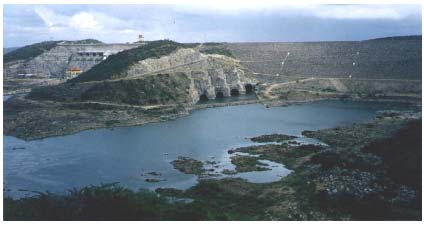
Picture 1. Dam of the Xingó Hydroelectric Power Plant.
The boost in energy consumption in the Region required the construction of river
regulating reservoirs, which were used for new power plants, such as Moxotó,
providing a weekly regulation of discharges in the São Francisco River. The
Sobradinho Power Plant's reservoir, with pluriannual regulation, assures a minimum
flow of 2,060 m3/s, in critical dry seasons. These sequential dams flood an area
equivalent to 5,222. 8 km2 .
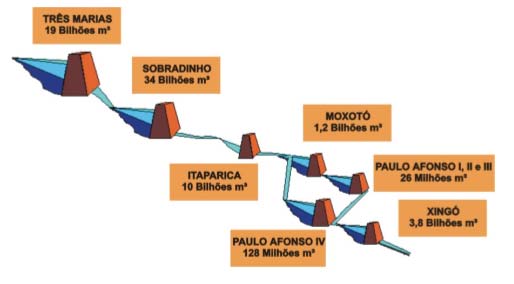
Figure 1 shows the hydroelectric exploitation in the São Francisco River. The volume
of water accumulated in the reservoirs is approximately 68 billion cubic meters.
Sobradinho is responsible for around 50% of that total volume, Xingó holds only 6% of
it.
Figure 1. Hydroelectric Exploitation in the São Francisco River.
ix
The Xingó Reservoir, closed in 1994, was the last reservoir built by CHESF
(Companhia Hidroelétrica do São Francisco). It is located between the 584900-640900
and the 8933200-8961200 UTM plane coordinates, between the States of Alagoas and
Sergipe, about 2 km upstream from the Municipality of Canindé do São Francisco (SE)
and 179 km from the River's mouth.
The Xingó Reservoir is the pilot area for the study on the reconstitution of the
ichthyofauna. Almost totally confined in the River's canyon, with a 60 km extension, at
cota 138 m, presenting a 60 km2 surface area and a total volume of 3.8 billion cubic
meters.
2.2. ENVIRONMENTAL DIAGNOSIS BRIEF
The ichthyofauna diagnosis, prepared prior to the filling of the Xingó Reservoir
(ENGE-RIO, 1992), identified only five fish species in the tributaries in its area of
indirect influence:
·
Astyanax bimaculatus (two-spot tetra),
·
Poecilia vivípara (no popular name),
·
Oreochromis niloticus (Nile tilapia),
·
Poecilia reticulata (no popular name),
·
Hypostomus sp. (carí).
For the area under the development's indirect influence45 fish species belonging to five
orders and 17 families were catalogued. The groups with the greatest number of species
were the characiforms (46.72%) and siluriforms (33.3%). Other less expressive orders
were the perciforms (11.1%), cyprinoids (4.4%) and clupeoid (4.4%).
2.3. ENVIRONMENTAL CHANGES BEFORE AND AFTER THE FILLING
The Basic Environmental Plan, prepared by the CHESF, includes several environmental
programs for the Xingó Power Plant Reservoir.
The physical-chemical analyses of the water(pH, nitrate, ammonia, dissolved oxygen
and total phosphor) were carried out before the reservoir was filled and during filling,
by the Department of Biological and Biomedical Sciences, of the Federal University of
Goiás, and after filling, by the Sanitation Company of Sergipe, in four Stations.
The nitrate rate in the post-filling period doubled, compared to that during the
construction of the dam, and was three times greater to that before filling. With respect
to the pH, there was a noticeable decrease in the post-filling period, compared to the
pre-filling (Figure 2).
2.4. PROMOTING THE PRODUCTION IN THE RESERVOIR
Traditional fishing in the Reservoir is practically nonexistent, even though verified in
some areas as indicated in location map of the fishing areas (Figure 3). It is an incipient
activity, concentrated on a few species and with a small volume of catches.
x
Figure 2. Limnologic parameters (nitrate and pH) in the Xingó Reservoir.
xi
xii
Figure 3. Fishing areas in the Xingó Reservoir.
xii
Given the hydrological changes, the reduction in the native ichthyofauna's biodiversity and the
drop in fishing production in the reservoir, two lines of promotion of the fish production stand out
as particularly important. The first consists of adding native fish to the management area (re-
populating) and the other involves the intensive raising of fish in floating tanks.
With respect to the stocking, a few questions still need to be addressed (the current structure of
the fish population in the reservoir, for example).
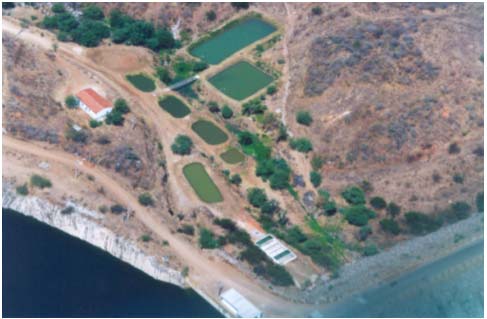
However, the infrastructure supporting fish reproduction, larva culture and native species'
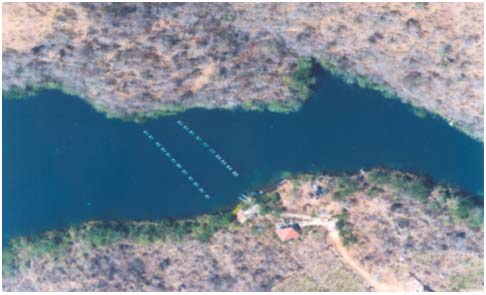
spawning was specially built (Picture 2) and the formation of a breeding stock was started. The
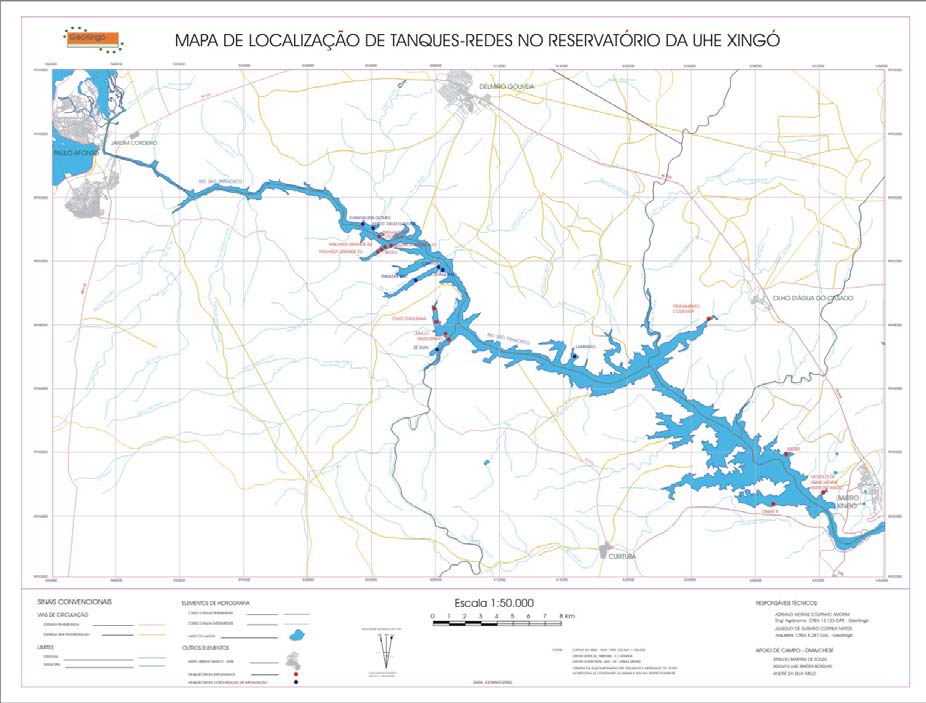
promotion of pisciculture in cages and/or in tanks, gained in importance, allowing the adoption of
the practice by the communities around the reservoir (Figure 4).
Picture 2. Vista aérea do complexo de reprodução de peixes do Instituto Xingó
Even though it consists of an intensive fish cultivation system requiring skills and knowledge, it
was possible to transfer, in a relatively short time, the production technology, through the
construction of a aquiculture production demonstrative unit (Picture 3). The beneficiaries were
fish farmers, technicians and associations (cooperatives and fish farmers' associations0
Picture 3. Demonstrative unit of fish production if floating tanks at the Xingó Institute.
xiii
ESCALA
ESCALA
Figure 4. Floating tanks' locations map (Xingó Reservoir).
3.
LIMNOLOGY IN THE XINGÓ RESERVOIR AND DOWNSTREAM REACH
The damming of the great rivers for building the hydroelectric power plants must be considered
the first impacts in the environment, causing a series of changes in the limnological
characteristics. It resulted, as well, in a reduction of the native ichthyofauna's biodiversity and,
frequently, in a decrease in the fishing production.
Systematical information on the limnology of the Lower São Francisco and adjacent coastal zone
were obtained four years after the reservoir was formed. The Stations were distributed taking into
consideration the reservoir's form, the confluence of the tributaries and the intake for domestic
supply. Of the 19 water collection Stations, for determining the abiotic parameters,
phyto/zooplankton and "a" chlorophyll, six are within the reservoir and 13 in the downstream
side (see Figure 5).
The temperature, electrical conductivity, dissolved oxygen (concentration and saturation), total
dissolved solids, salinity and pH were determined in situ, with the use of portable measurement
devices. Water transparency was estimated by the reading of the depth at which de Secchi disk
xiv
was no longer seen. Nitrate, phosphate, ammonia, silicon and "a" chlorophyll (Strickland and
Parsons, 1972) were determined in the Hydro-Chemical Laboratory (LABMAR/UFAL).
Figure 5. Location of the water collection Stations in the Xingó Reservoir and in the
downstream side.
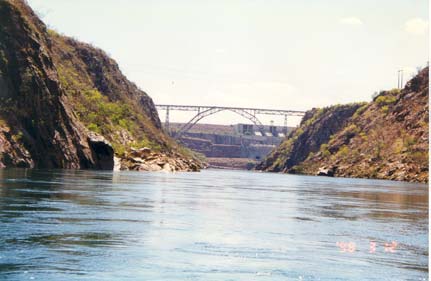
Picture 4. Station 1 (downstream from
Picture 5. Station 7 (downstream from
Paulo Afonso IV Power Plant).
the Xingó Power Plant).
xv
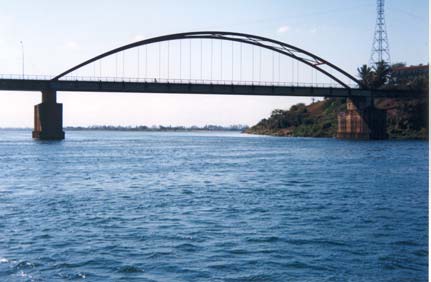
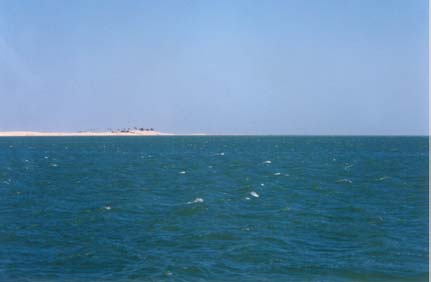
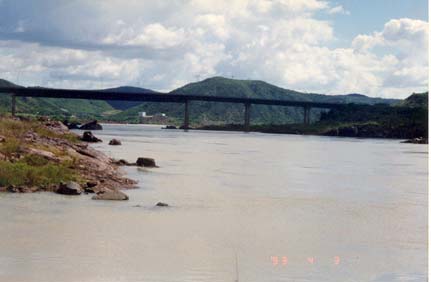
Picture 6. Station 14 (Própria-SE).
Picture 7. Station 19, at the mouth of the
São Francisco.
3.1. PHYSICAL AND CHEMICAL VARIABLES
3.1.1. Water Temperature
Water temperature in the Reservoir, in 1998/99, varied from 23.7 to 31.0 ºC, at the surface, to 21
to 30ºC, at the bottom. In the downstream reach, the values verified for both surface and bottom
presented the same ranges, 26 to 30 ºC.
In the third quarter of 1998, there was a small oscillation in temperature in the Stations. At the
surface, it varied from 27 to 29ºC and, at the bottom, from 26 to 28º C. In the same period in
1999, it varied from 23.7 to 26.2°C and from 23.9 to 26.2°C, respectively. In the downstream
reach, the values for surface and bottom presented, in 1998 and 1999, a variation from 24 to 28.1º
C (Figure 6).
Figure 6. Temperature longitudinal variation's pattern, between Paulo Afonso and the
São Francisco's mouth.
3.1.2. Electrical conductivity
In the samples from the Reservoir, the electrical conductivity varied from 59.5 to 84 µS/cm, at
the surface, and from 58.5 to 84µS/cm in the bottom, in the year of 1998. In the downstream
xvi
reach, variation at the surface was from 59.4 to 2,310 µS/cm, and from 59 to 5,200 µS/cm, at the
bottom.
In 1999, the Reservoir presented a surface variation from 61.2 to 72.5 µS/cm and from 59.2 to
70.3 µS/cm at the bottom. In the downstream reach, the electrical conductivity varied from 56.3
to 27,400, at the surface, and from 61.3 to 41,400 at the bottom. At Station 19, given the
influence of the maritime environment, the electrical conductivity presents high values.
3.1.3. Dissolved Oxygen (DO)
The dissolved oxygen's (DO) content varied between 6.8 and 9.6 mg/l, at the surface of the
Reservoir, and from 4.8 to 8.7 mg/l at the bottom, in 1998. The lowest contents of oxygen were
verified at Station 5 (Figure 7). Downstream from Xingó´s Power Plant, oxygen content at the
surface varied from 6.6 to 13.6 mg/l, corresponding to 82.2 to 177.1% saturation. and from 6.6 to
13.8 mg/l at the bottom.
Figure 7. Dissolved Oxygen's longitudinal variation pattern in the stretch from Paulo
Afonso to the São Francisco`s mouth.
3.1.4. Hydrogen Ionic Potential
The water's pH at Xingó and in the downstream reach remained alkaline (7.24 to 8.42), except
for the 3rd Quarter (1998 and 1999), at Stations 2, 4, 5, 7 and 11 (pH =6).
3.1.5. Water Transparency
Water transparency, measured with the Secchi disk, presents higher values in the Reservoir, with
a mean variation from 2.2 to 6.6 m, against a 1.8 to 5.3 m at the downstream reach..
Even though the indices determined from the depth of disappearance of the Secchi disk are not to
be used alone, to assess the trophic conditions of the environment, an initial trial was used in this
study. Chart 3 shows the trophic classification of the Lower São Francisco, according to those
indices.
3.1.6. Nutrients:
· Phosphate
xvii
The phosphate content in the reservoir varied from 0.6 to 48 µg/l, and from 0.5 to 47 µg/l, in the
downstream reach, in 1998. In 1999, the Reservoir presented a variation from 0.2 to 26.7 µg/l and
the downstream reach from 0.2 to 21.6 µg/l. The greatest phosphate contents were verified in the
2nd and 3rd Quarters (June and December), in the two years of study. (see Figure 8).
Chart 3. Classification of the Lower São Francisco, according to the depth of the Secchi
disk and to the Carlson Index of Trophic Condition (ITC).
Trophic Condition Index
Zds
Collection site
Months
ITC(S)
ITC (S)*
Zds**
(m)
Classification Classification
Mar/98 5.7 34.89 Oligotrophic
Oligotrophic
Jun/98 5.3 35.94 Oligotrophic
Oligotrophic
Xingó Reservoir
Sep/98 6.2 33.68 Oligotrophic
Oligotrophic
Dec/98 6.6 32.78 Oligotrophic
Oligotrophic
Mar/98 4.4 38.62 Oligotrophic
Oligotrophic-Mesotrophic
Jun/98 3.7 41.12 Mesotrófico
Mesotrófico
Downstream
from Xingó
Sep/98 4.9 37.07 Oligotrophic
Oligotrophic
Dec/98 5.3 35.94 Oligotrophic
Oligotrophic
** Zds = Depth of the Secchi disk (m)
50
50
40
40
30
30
20
20
10
10
0
0
Figure 8. Phosphate's longitudinal variation pattern in the stretch from Paulo Afonso to
the São Francisco`s mouth.
According to the criteria presented by Vollenweider (1968) for the total phosphor, most part of
the determined values indicates that both the Reservoir and the downstream reach might be
classified as oligomesotrophic-mesoeutrophic (see Chart 4).
xviii
Chart 4. Classification of the Lower São Francisco according to the
concentration of total phosphor
Total
Trophic Condition (P-total)
Collection site
Months
phosphor
* VOLLENWEIDER (1968)
(µg/l)
Classification
Mar/98
23.0
Mesoeutrophic
Jun/98
20.0
Mesoeutrophic
Xingó Reservoir
Sep/98
9.0
Oligomesotrophic
Dec/98
18.0
Mesoeutrophic
Mar/98
23.0
Mesoeutrophic
Jun/98
19.8
Mesoeutrophic
Downstream
from Xingó
Sep/98
5.6
Oligomesotrophic
Dec/98
5.6
Oligomesotrophic
· Nitrato e Amônia
The minimum and maximum nutrient concentration values in the Reservoir, represented by the
ammonia (N.NH4) and nitrate (N.NO3), are presented in Chart 5.
Chart 5 Minimum and Maximum ammonia and nitrate values in the Lower São Francisco
(1998/99)
RESERVOIR
Surface Bottom
Parameters
minimum maximum minimum maximum
1998 1999 1998 1999 1998 1999 1998 1999
Ammonia (mg/l) 0.0130 0.0500 1.5910 0.2140 0.0180 0.0070 1.6800 0.3360
Nitrate (mg/l)
0.0010 0.0190 0.0980 0.2010 0.0020 0.0230 0.1140 0.2250
According to the classification criteria presented by Vollenweider (1968), for ammonia and
nitrate contents, the Xingó Reservoir might be considered as oligotrophic oligotrophic.
xix
3.2. BIOLOGICAL
VARIABLES
· Chlorophyll
Chlorophyll concentration at the reservoir's surface varied from 0.01 to 13.52 µg/l and from 0.01
to 8.18 µg/l at the bottom. In the downstream reach, it varied from 0.01 to 4.09 µg/l, at the
surface, and from 0.01 to 5.66 µg/l at the bottom.
Based on the estimated mean values, chlorophyll concentration was higher in the reservoir. The
verified values in the 1999 campaign were higher those observed in 1998 (see Figure 9).
Figure 9. Chlorophyll's longitudinal variation pattern in the stretch from Paulo Afonso
to the São Francisco`s mouth.
4.
THE PHYTO AND ZOOPLANKTONIC COMMUNITIES N THE XINGÓ
RESERVOIR
The study of the phyto and zooplanktonic communities is fundamental to the understanding of
the bio-ecologic dynamics of the aquatic ecosystems, especially regarding nutrient replacement
and energy flux.
In tropical regions, nutrient availability and subaquatic radiation are among the most important
abiotic factors. Among the biotic factors are the herbivory and parasitism. Especially in
reservoirs, besides the nutrient availability and subaquatic radiation, the phytoplanktonic
behavior is associated also to the relation between hydrologic cycles reservoir operation, which
affects the discharges and the constant loss of biologic material, given the releases through the
turbines and spillways (Brondi, 1994; Calijuri et al., 1999).
Several studies have proven that changes in zooplanktonic community's structure and dynamics
will lead to changes in the whole trophic network in the reservoir. The phyto and zooplanktonic
communities in the Xingó Reservoir were studied in 1998 and 1999, in the same six Stations
where the limnologic supervision was implemented, viewing the observation of the spatial and
temporal variations of the main groups of organisms, in quantitative and qualitative terms.
The draggings were carried out in the surface layer, with the boat in slow motion, with a speed
around 1 knot, for approximately three minutes, with two plankton nets, with 45 µm and 140 µm,
for phyto and zooplankton, respectively.
xx
4.1. PHYTOPLANKTONIC
COMPOSITION
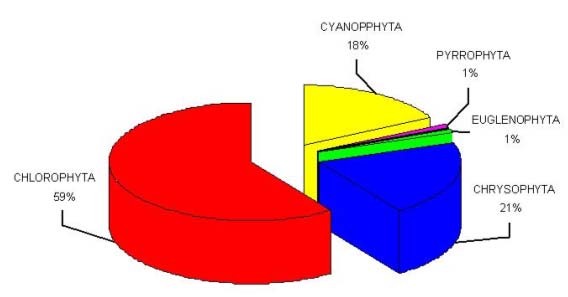
The phytoplanktonic community in the Xingó Reservoir was represented by 91 taxons (16
Cyanophyta, 1 Pyrrophyta, 1 Euglenophyta, 19 Chrysophyta and 54 Chlorophyta). The
Chloropyta division was the most representative, with 59% of the identified species, followed by
the Chrysophyta with 21% and the Cyanophyta with 18% (Figure 10).
Figure 10. Distribution of the Phytoplanktonic Community (Xingó Reservoir, 1998/99).
According to the wealth of species and to its distribution in the collection stations in the Xingó
Reservoir, it was noticed that the number of taxons of the Chlorophyta division was superior to
those of the other divisions, in all Stations, and particularly in the Stations 1 through 4, in 1998,
and in Stations 1 and 3, in 1999, where it was represented by over 40 species (see Figure 11).
Figure 11. Qualitative distribution of the phytoplanktonic groups in the six collection
Stations in the Xingó Reservoir (19998/99).
xxi
4.1.1. Relative Abundance and Spatial and Temporal Variations
According to the relative abundance of the identified species, it was verified that there was no
dominant species. Most part of the taxons is characterized as rare, meaning a relative abundance
inferior to 10%. The most representative species was the chlorophycea Oöcystis sp, with a 48.3%
abundance, in Station 6, in 1998. It was the only one classified as abundant (40 - 70,0%).
4.1.2. Occurrence and Density Frequencies
· Frequency of Occurrence
Regarding the frequency of occurrence, it was noticed that most of the species (43) was
considered very frequent, for being present in more than 70% of the analyzed samples. Only eight
of the species were considered sporadic, occurring in less than 10% of the samples.
The following taxons occurred in all the stations , in both periods of study, being , therefore,
classified as very frequent: The cyanophyceae Aphanothece sp, Chroococcus sp, Coelosphaerium
sp and Gloeocapsa sp; dinoflagellate Peridinium sp; euglenophyceae Phacus sp; diatomaceae
Aulacoseira granulata and Fragilaria crotonensis and chlorophyceaea Botrycoccus sp,
Coelastrum sphaericum, Cosmarium sp, Eudorina elegans, Eutetramorus fotii, Sphaerocystis
schroeteri, Sphaerozosma sp, Spondylosium sp, Staurodesmus triangularis, Staurodesmu sp,
Staurastrum arctiscon, Staurastrum leptocladum, Staurastrum rotula and Stautastrum sp.
Density (cel. L-1).
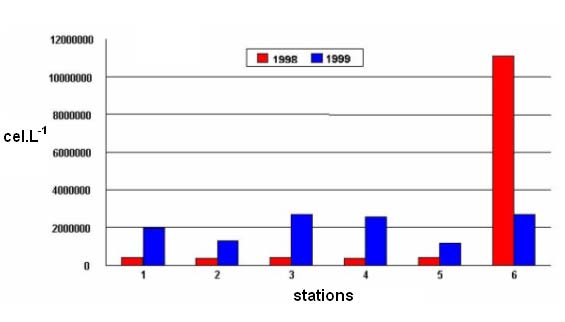
The total phytoplanktonic density presented a great flourishing at station 6, in 1998, with a
111,105,441 cel.L-1 value. At the other stations, in the two periods of study, a very uniform
distribution in density values was verified. In 1999, however, cell density values were greater (the
maximum density was registered at Station 3, with 27,084,257 cel. L-1).
In 1998, with the exception of Station 6, the density values were close to each other, with a
maximum of 4,156,509 cel.L-1, in Station 5, and a minimum of 3,688,665 cel.L-1, in Station 4
(see Figure 12).
Figure 12. Distribution of phytoplanktonic density (Xingó Reservoir, 1998/99).
xxii
The phytoplankton presents a non-uniformity in its spatial and temporal distribution, fact related
to the Wind action, precipitation, solar radiation, nutrient availability and, in the case of the dams,
with the spillway and turbine releases, in addition to time of residence of the water (Brondi,
1994).
Analysis of the monthly samples revealed that densities were greater in 1999. However, in March
of 1998, the chlorophyta division presented a high value of 71,322,333 cel. L-1, deserving
mention throughout the year. In 1999, the greatest densities were verified in the month of
September, when the Chlorophyta presented 28,902,492 cel. L-1 and the Chrysophyta 19,242,144
cel. L-1 (see Figure 13).
Figure 13. Temporal distribution of the density of phytoplanktonic group (Xingó, 98/99).
4.1.3. Specific Diversity and Equitability
The biological diversity is representative of the wealth of species in a given community or
geographic area. From an ecologic point of view, it is more than just the number of species in a
given area, as it depends on the relative abundance of each taxon in the considered environment
(Matsumura-Tundisi, 1999 apud Margalef, 1977).
The study of the specific diversity indicates the degree of complexity of the community.
Therefore, when a community is dominated by one or more species, when individuals of rare
species are substituted by other from more common species, or when some species breed more
rapidly, the diversity decreases (Omori & Ikeda, 1984). Studies involving the diversity contribute
to a better understanding of the trophic conditions in a given ecosystem.
The lowest diversity found was 3.52 bits.cel-1, verified at Station 6, in 1998. For Reed (1978),
high diversities are verified in stable environments, resulting from the presence of many species,
some becoming established, other in their populational peaks and other in declination (see Figure
14).
xxiii
Figure 14. Diversidade específica da comunidade fitoplanctônica no reservatório de Xingó,
nos anos de 1998 e 1999.
Based on diversity values, Margalef (1981) characterized as fertile waters those whose diversity
of the phytoplanktonic community varied from 1.0 and 2.5 bits, and as clean waters those with
values in the 3.0 to 4.5 bits range. In such case, Xingó's water might be considered as clean (see
Chart 6).
Chart 6. Characterization of the Xingó Reservoir, according to the biodiversity values for
phytoplanktonic communities.
Environments
Margalef (1981)
Xingó Reservoir (98/99)
Fertile lakes
1 2.5 bits.cel-1 ----------
Clean waters
3 4.5 bits.cel-1
3.52 5.20 bits.cel-1
The equitability values were above 0.50 (0.86 at Station 5, in 1998, and 0.60 at Station 6, in
1999), indicating a equitative distribution of the species, without dominant taxons in the
community.
4.2. ZOOPLANKTONIC
COMPOSITION
4.2.1. Composition
and Relative Abundance
The zooplanktonic composition in Ana artificial lake (dam/reservoir) differs from that of natural
lakes, with respect to the relative abundance of the main groups of components. In limnetic
ecosystems, the truly phytoplanktonic organisms are distributed among three main groups:
Rotifer, Cladoceran e Copepod (Matsumura-Tundisi, 1999). The Rotifer group with 27 taxons
(29.77%), the Cladoceran with 17 taxons (37.57%) and the Copepod with 7 taxons (26.59%).
Additionally, the occurrence of Protozoan (2.73%), Nematodes Ostracod and Insecta was
verified, representing 3.35% of the analyzed community (see Figures 15).
xxiv
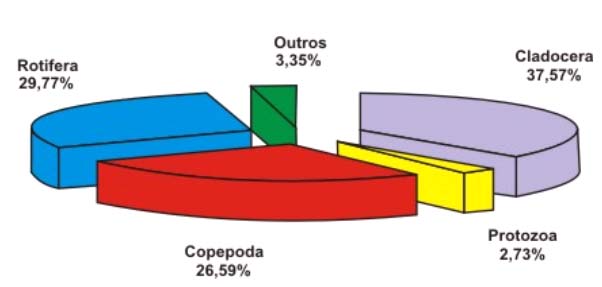
The mean annual relative abundances of the analyzed zooplankton were classified as dominant,
abundant, little abundant and rare organisms. The Rotifer Brachionus patulus was the only
dominant species, ocurring at Station 5, in 1998., with a 72.59% abundance.
Figure 15. Mean annual relative abundance of the zooplanktonic
community in the Xingó Reservoir.
The individuals with the greatest percentages of relative abundance, considering those with
values above 10%, are the Rotifer Brachionus patulus and Keratella cochlearis; the Cladoceran
Bosminopsis deitersis, Bosmina longirostris and Ceriodaphnia cornuta, and the Copepod
Calanoida with the species Notodiaptomus cearensi.
Studies carried out in 23 reservoirs in the State of São Paulo (Tundisi et. al/1988 and Matsumura-
Tundisi/1999) mention the calanoida as dominant species in oligomesotrophic systems , while the
cyclopoida dominate in highly eutrophic systems. It was verified that the Copepod contributed
significantly to the numbers in the stations under study, with the Calanoida Notodiaptomus
cearensis being the dominant species, suggesting that the Xingó Reservoir is an oligomesotrophic
environment.
4.2.2. Specific Diversity and Equitability
The biological diversity might be used for expressing only the wealth of species in an area. But,
according to Margalef (1983), from an ecological standpoint, it is more than that, depending also
of the relative abundance of each species, and how they are distributed in relation to each other.
In this study, the diversity was assessed through a mathematical formulation, considering both the
number of species in each station and their relative abundance. Shannon Winner index was used
as reference.
Specific diversity indices, estimated based on the relative abundance of each infrageneric taxon,
indicated that the zooplanktonic community, in the six stations studied in 1998 and 1999, is
characterized by a high to medium diversity, showing a well diversified zooplanktonic structure.
Of the 48 analyzed samples, during the study, 83.33% presented values under 3 bits.ind-1 and
above 2 bits.ind-1, with indices varying from 1.26 bits.ind-1 (Station 5, 1998). This was, probably,
due to the dominance of the Rotifer Brachionus patulus (72.59%) over the other species, with a
xxv
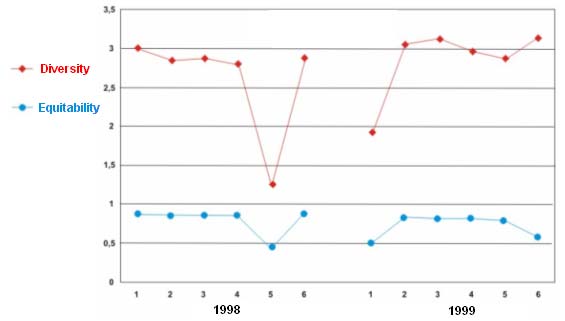
maximum of 3.16 bits.ind-1 (Station 6, 1999). Similar values were verified in other tropical lake
systems, in Brazil (Silva /1997, Domingos /1993, Matsumura-Tundisi /1999 and Newmann-
Leitão /1994).
Regarding the equitability, the taxons in the zooplanktonic community were well distributed,
with values oscillating between 0.45 and 0.89, with only one dominant species, the Brachionus
patulus. Of the 48 samples, 75% presented values between 0.80 and 0.89, and the remaining
between 0.45 and 0.59. In general, they all presented uniform distribution (Figure 16).
4.2.3. Total density and Spatial and Temporal Variation
The total zooplanktonic density in the period presented higher values in 1998, with little
oscillations. It was registered a minimum value of 1,109 org.m-3 (Station 6, in September, 1999)
and a maximum of 2,947 org.m-3 (Station 3, in March 1998). In a general way, considering the
seasonality, there was a reduction in the months of March and December, in both years, with
peaks in the months of September/98 and June/99.
Figure 16. Zooplanktonic Specific Diversity and Equitability in the Xingó
Reservoir, in March, June, September and October, 1998 and 1999.
Regarding the spatial and temporal distribution of the zooplanktonic in the Xingó Reservoir,
small variations were detected with respect to the factors affecting the their distribution. In the
samples, it was verified a constant presence of the Rotifer Brachionus patulus, Keratella
cochlearis and Conochilus dossuarius, the Cladoceran Bosminopsis deitersi, Bosmina
longirostris, Bosmina hagmanni, Moina minuta and Cereiodaphnia cornuta, the Copepod
Notodiaptomus cearensis, Pseudodiaptomus richardi, Pseudiaptomus gracilis and
Thermocyclops minutus , as well as Copepod nauplius.
In 83.33 % of the samples, the Rotaria sp., Keratella americana, Cladoceran nauplius,
Termocyclops decipiens and Paracyclops sp were present. Other species were less frequent and
sporadic.
xxvi
5.
THE LOWER SÃO FRANCISCO ICHTHYOFAUNA
5.1. SAN FRANCISCO BASIN DURVEYS
In the book "Geeology and Physical Geography of Brazil", originally published in 1870, Charles
Frederick Hartt makes considerations about the Lower São Francisco's ichthyofauna, with
important notes on the biology of the true Piranha (Hartt,1941).
According to Paiva & Campos (1995), the ichthyologist John Diederich Haseman travelled
through Northeastern Brazil, between November of 1907 and April of 1908, by the Middle and
Lower São Francisco, and made the following findings:
i) The occurrence of cichlid in the basin;
ii) an increase in the number of registered fish;
iii) indication that almost all fish species of the Itapecuru River were found in the São
Francisco; and
iv) the possibility of the Sanfranciscan fish pass over the Paulo Afonso Falls, in their
upstream migrations, during the great floods.
Other ecological investigations in the San Francisco Basin were carried out by Travassos,
permitting the elaboration of a directory of the Sanfranciscan fish (Travassos,1960).
Johann Julius Walbaum, in 1972, described the first fish of the San Francisco River Basin, the
Prochilodus marggravii, known as curimatá. In the beginning of the XIX Century (1817 to
1830), the Baron of Cuvier described some fish known as dourado (Salminus brasiliensis), red-
tail piaba (Astyanax fasciatus), piranha (Serrasalmus piraya) and croaker (Pachyurus francisci).
5.2. SPECIFIC COMPOSITION POSIÇÃO ESPECÍFICA
COSTA et all (2000), analyzing the ichthyofauna disembarked in eight Municipalities of the
Lower São Francisco (AL/SE), registered the occurrence of 33 freshwater species, seven of
which had been introduced and one was a hybrid (tambacu). The marine/estuarine species were
represented by 14 species (see Chart 7).
Chart 7. Fish species disembarked in Municipalities of the Lower São Francisco (1998/99)
Freshwater Species
Marine/Estuarine Species
Scientific name
Popular name
Scientific name
Popular name
Steindacherina elegans
Aragu
Catfish sp.
Catfish
Leporinus piau
Black Piau
Selenaspis herzbergii
Sea catfish
Leporinus sp.
Three-spotted Piau
Caranx sp.
Cavalla
Schizodou knerii
White Piau
Eugerres brasiliensis
Mojarra
Salminus hilarii
White Tubarana
Centropomus paralellus
Snook
xxvii
Centropomus pectinatus
Tarpon snook
Centropomus pectinatus
Tarpon snook
Prochilodus sp.
Curimatá
Tarpon atlanticus
Tarpon
Prochilodus argenteus
Xira
Anchoviella lepidentostole Anchovy
Prochilodus costatus
Curimatá
Stellifer sp.
Cabeça de côco
Pseudoplatystoma coruscans Sorubim
Lutjanus sp.
Red snapper
Serrasalmus rhombeus
Black Piranha
Mugil brasiliensis
Curimã
Serrasalmus piraya
Red Piranha
Mugil sp.
Mullet
Serrasalmus brandii
Green piranha
Hyporhamphus sp.
Halfbeak
Myleus micans
Pacu
Gerres sp.
Mojarra
Pimelodus maculatus
Spotted Pim
Cichla ocellaris
Peacock bass
Cichla sp.
Peacock bass
Lophiosilurus alexandri
Pacman catfish
Pseudopimelodus zungaro
Pakamon
Hoplias malabaricus
Tiger fish
Cichlasoma sp.
Black Acara
Colossoma macropomum
Black Pacu
Pachyurus francisci
San Francisco's
croaker
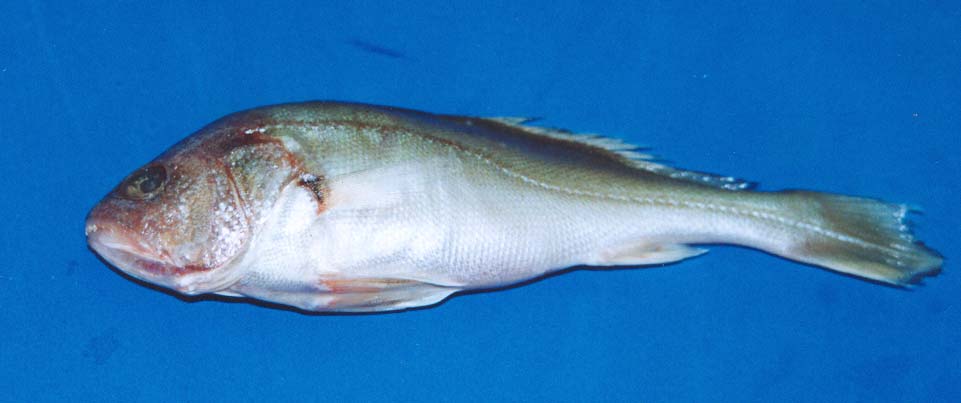
Pachyurus squamipinnis
croaker
Hypostomus commersonii
Carí
Hypostomus margaritifer
Painted Carí
Sternopygus macrurus
weakly electric fish
Oreochromis niloticus
Tilapia
Plagioscion squamosissimus Silver croaker
Cyprinus carpio
Carp
Acestrorhyncus lacustris
Lambiá
Parauchenipterus galeatus
Woodcatfish
Astronotus ocellatus
Oscar
The following sequence of pictures is part of a Documentary on the Ichthyofauna and Fishing
on the Alagoan São Francisco, in the stretch between Xingó and the mouth of the São
Francisco, under preparation by Costa (2003).
xxviii
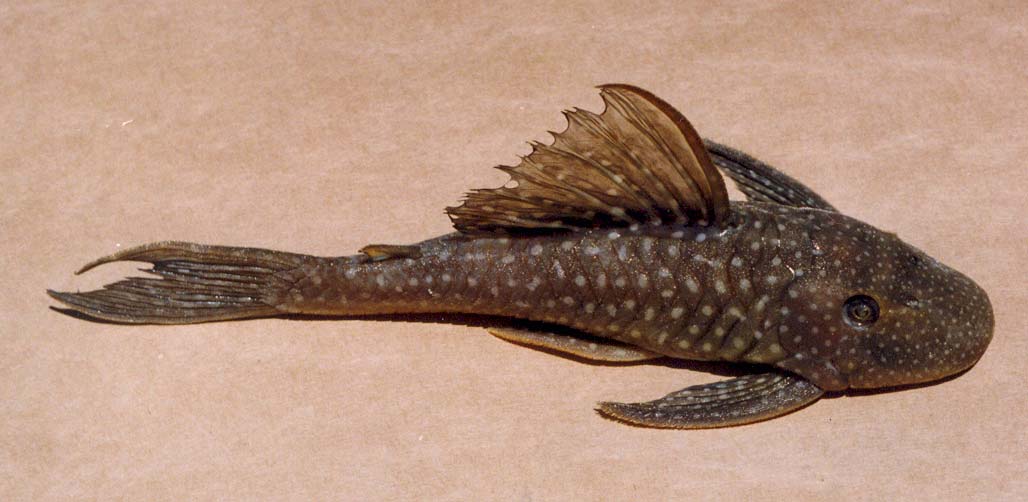
Picture 8. Cari (Hypostomus sp.).
The cari or cascarudos belong to the Loricariidae Family, common in South America, with
hundreds of species. They are bottom fish, from where they scrap the substratum for food.
A
B
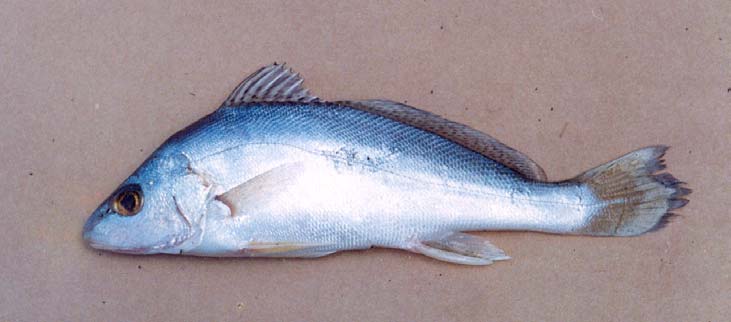
Picture 9. Croaker (A Pachyurus squamipinnis) (B Pachyurus francisci).
The majority of the representatives of this family are from the sea, and the most common species
are known as croakers, hakes or pescadas.
xxix
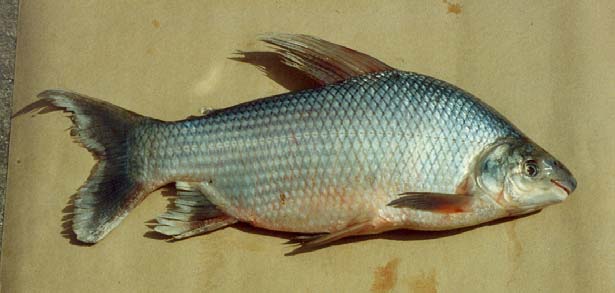
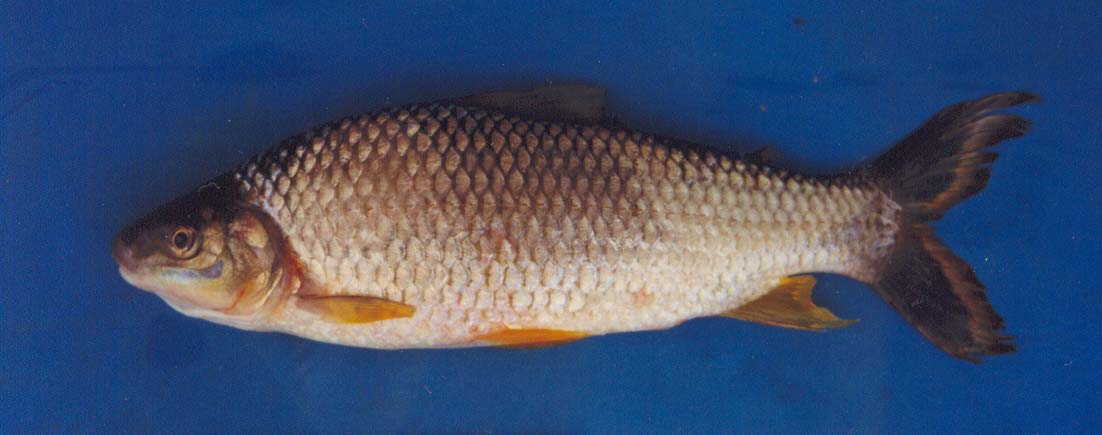
Picture 10. Curimatá (Prochilodus sp.).
The curimatás belong to the Prochilodontidae Family, feeding from the bottom of rivers and
lakes. They are fish of great importance in the fluvial fishing.
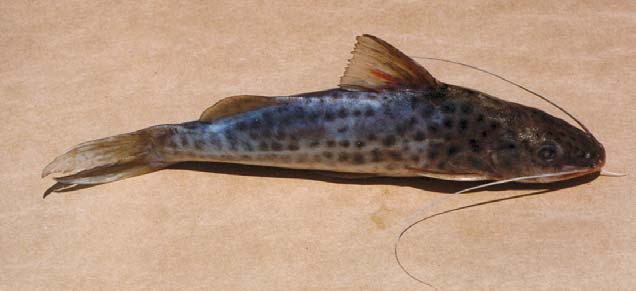
Picture 11. Yellow Pim (Pimelodus maculatus).
The yellow pims belong to the Pimelodidae Family and occur in many diversified forms.
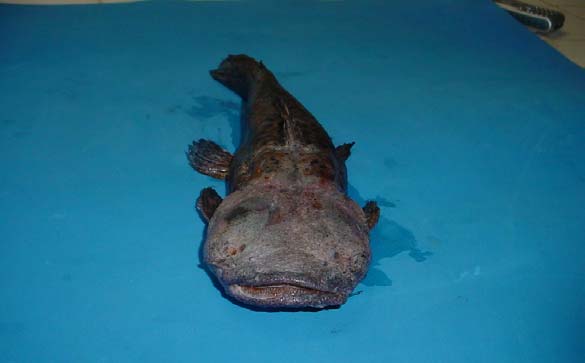
Picture 12. Pacman catfish (Lophiosilurus alexandri).
The pacman catfish belongs to the Pimelodidae Family, being a native of the São Francisco River
Basin, also known as pakamon.
xxx
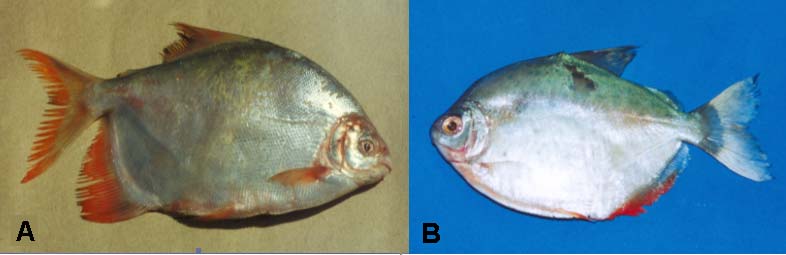
Picture 13. Pacu (Myleus micans).
In South America, the Characidae Family comprehends around 30 sub-families, including fish
with diversified feeding habits. The pacu represent the Myleinae Sub-Family.
A
B
B
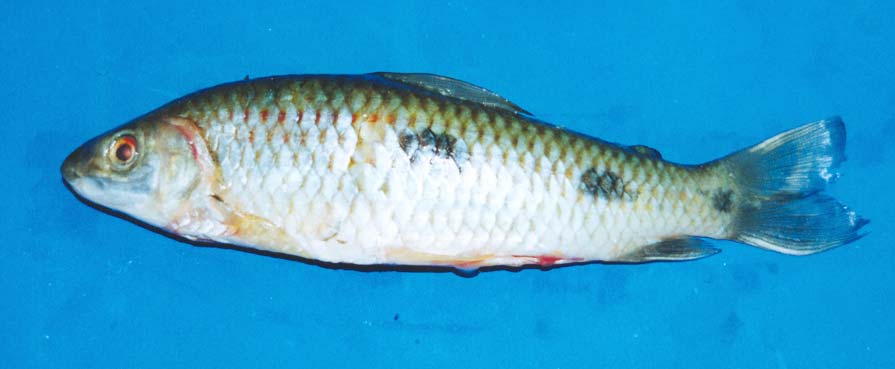
Picture 14. White Piau (A Schizodon knerii) and Three-spotted Piau (B Leporinus sp).
The piaus belong to the Anostomidae Family, being herbivorous fish.
xxxi
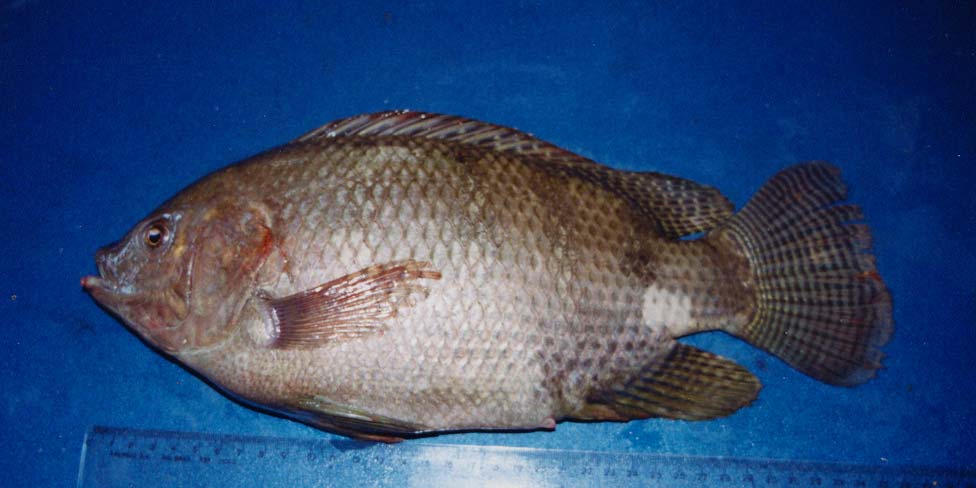
Picture 15. Tilapia (Oreochromis niloticus).
Originally from Africa, it was introduced in Brazil in 1971. Belonging to the Cichlidae Family, it
is also
A known as Nile tilapia.
B
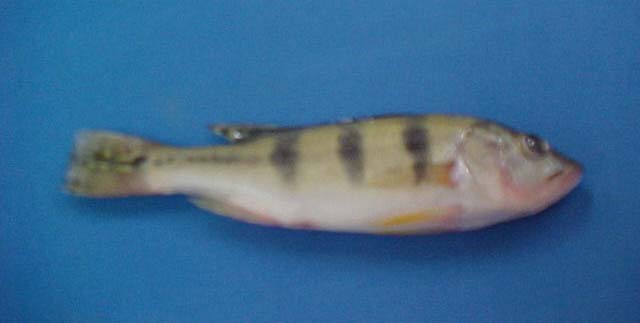
Picture 16. Peacock bass A (Cichla ocellaris) e B (Cichla sp.).
The peacock bass are carnivorous fish, originally from the Amazon basin.
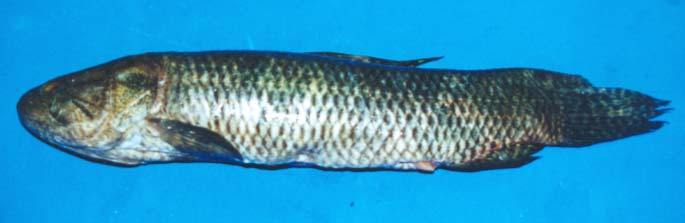
Picture 17. Tiger fish (Hoplias aff. malabaricus).
The tiger fish, belonging to the Erythrinidae Family, are a carnivorous species, predators, vastly
distributed in South America. They prefer still water environments.
xxxii
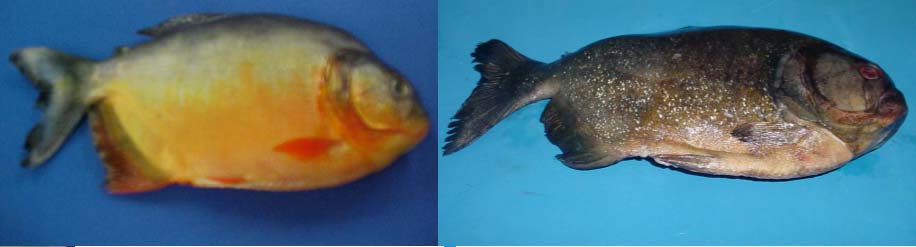
Picture 18. Red Piranha (Serrasalmus piraya) and Black Piranha (Serrasalmus sp).
Belonging t
A
o the Characidae Family, they are carnivorous predator fish, capable of tearing pieces
of their preys with their Sharp jaws.
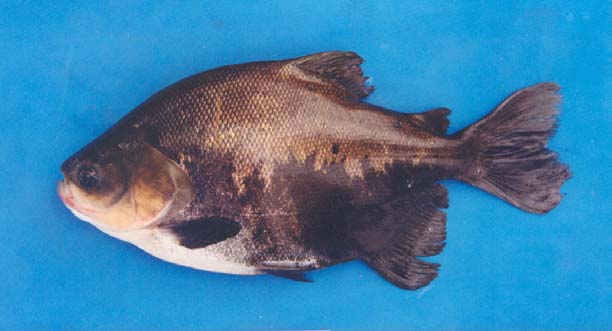
Picture 19. Black pacu (Colossoma macropomum).
Belonging to the Characidae Family, originally from the Amazon Basin, it is an herbivorous fish,
eating preferably fruits.
Marques (1995) verified the occurrence of 21 fish species belonging to 12 families in the
permanently flooded area of the Marituba Floodplains, in the Lower São Francisco, located in the
Municipalities of Feliz Deserto, Piaçabuçú and Penedo (see Chart 8).
Chart 8. Fish species in the Marituba Floodplains
Scientific name
Popular name
Astyanax bimaculatus
Two-spot tetra
Creatochanes affinis
Red-topped tetra
Moenkhausia costae
Tetra
xxxiii
Roeboides xenodon
Tetra
Acestrorhyncus lacustris
Lambiá
Serrasalmus brandtii
Green Piranha
Serrasalmus piraya
True (black-tailed) piranha
Hoplias aff. Malabaricus
(Tiger fish)
Erythrinus cf. erythrinus
Wolf-fish
Leporinus piau
Black piau
Steindachnerina elegans
Aragu
Prochilodus argenteus
Xira
Gymnotus carapo
Banded knifefish
Sternopygus macrurus
Ghost knifefish
Parauchenipterus galeatus
Woodcatfish
Callichthys callichthys
Armoured catfish
Synbranchus marmoratus
Marbled swamp eel
Crenicichla lepidota
Pike cichlid
Cichlasoma sanctifranciscense
Cará
Centropomus parallelus
Fat snook
Pseudoplastystoma coruscans
Sorubim
Still according to Marques (2001), the fish biodiversity is perceived by the riverine men, who is
able to distinguish 9 species of tetra.
Continuing with the research begun more than a decade ago, there is the investigation on the
"Ecological Characterization of the Marituba Floodplains I Ichthyology and Limnology of the
Marituba do Peixe Environmental Protection Area". The first samples collection for the Projetc
showed that species Eigenmannia trilineata, popularly known in the Region as tubí, whose
distribution had only been registered in the Paraná and Paraguay Rivers Basins, occurs also in the
São Francisco, That was the first record in the Basin (Sá et all, 2003).
5.3. INTRODUCED
SPECIES
The dispersion mechanisms, as well as those responsible for introducing new species from the
different continents, countries or basins, to the São Francisco Basin, are not sufficiently clear.
The silver croaker (Plagiooscion squamossissimus) was introduced in the Sobradinho Reservoir,
by DNOCS, trough fish releases.
xxxiv
In general, the dispersion mechanisms are associated to the increment in pisciculture in the Basin,
which, according to Welcomme (1989), was the case for 41% of the 237 new species. Another
way was the stocking of exotic species (aloctone) in the reservoirs, by the electrical sector
companies.
Even tough the transference of fish species between regions may be an old practice, the
associated risks are high and, in the current stage of knowledge, it is difficult to assess the
environmental cost of such introductions.
In the particular case of the São Francisco, the introduced species were represented by the
peacock bass (Cichla ocellaris and Cichla sp.), black pacu (Colossoma macropomum), Nile
tilapia (Oreochromis niloticus), Carp (Cyprinus carpio), Oscar (Astronotus ocellatus), silver
croaker (Plagioscion squamosissimus) and a hybrid known as tambacu.
The statistical analysis of fishing on the Lower São Francisco (1998/99) reveals that the peacock
bass is one of the main species, regarding the volume of capture.
5.4. ENDANGERED SPECIES
The fishermen of the Alagoan Lower São Francisco point to a decrease in fish and the
disappearance of at least 12 species: The yellow pim (Pimelodus maculatus), Aragu
(Steindacherina elegans), Woodcatfish (Parauchenipterus galeatus), Lambiá (Acestrorhyncus
lacustris), Pacman catfish (Lophiosilurus alexandri), Xira (Prochilodus argenteus), Dourado
(Salminus brasiliensis), Sorubim (Pseudoplatystoma coruscans), Pirá (Conorhynchus
conirostris), Anchovy (Anchoviella lepidentostole), three-spotted piau (Leporinus sp.) and tetra
(Moenkhausia costae).
Control of fish disembarkment in the years of 1998 and 99 contributes to the fishermen's
perception. The sorubim and the dourado had little representation. As to the pirá, considered the
icon of the Lower São Francisco, there has been no records of its existence for at least 15 years.
The impacts on the structure and operation of the fragile and rich ecosystems affected not only
the migratory fish, but also the sedentary species, such as the pacman catfish. Other species had
their population reduced to a point they could no longer be exploited, as is the case of the three-
spotted piau, in the Marituba Floodplains region.
5.5. IMPACTS ON THE ICHTHYOFAUNA
Adverse environmental impacts of the dams on the fish communities have been investigated by
many authors, specially in those basins which suffered great interventions, as in Iguaçu, Paraná
and São Francisco Rivers. In general, the changes resulting from those interventions are very
similar. Examples are:
· Changes in flow and quality of the water;
· Impediment to migratory reproduction;
xxxv
· Changes from a lotic to a lentic regime;
· Modification of the aquatic communities' structure.
The sequential dams built along the São Francisco River reduced significantly the downstream
floods, preventing the flooding of the marginal lagoons and, consequently, the entrance of larvae
and fish eggs in these habitats.
According to the environmental prognostic (ENGE-RIO, 1992), the construction of the Xingó
Power Plant would imply in changes in the composition, distribution and abundance of the fauna,
both upstream and downstream from the dam.
The change from a lotic to a lentic aquatic environment, a s well as the resulting changes in water
characteristics, will lead to the disappearance, in the area of the reservoir, of fish species that are
characteristic to the lotic oxygened environments. This will occur at least to the black carí
(Pterygoplichthys etentaculatus) and the painted carí (Hipostomus margaritifer).
Among the species which will not be able to migrate upstream are the white piau (Schizodon
knerii), the matrinchão (Brycon lundi), the curimatá (Prochilodus affinis), the pacu (Myleus
micans) and the pirá (Conorhynchus conirostris). Besides those, there are the typically marine
species inhabiting the area, such as the Tarpon snook (Centropomus pectinatus) and the anchovy
(Anchoviella lepidentostole), which will no longer reach regions upstream from the dam.
The diagnostic and guidelines for continental fishing (MMA, 1998) confirm that the sequence of
upstream dams (CHESF's) would have contributed to significant changes in the composition of
the commercial fish in the Lower São Francisco.
The construction of dikes along some tributaries, for protecting irrigation projects and riverine
communities, against floods, also impeded the entrance of larvae and fish eggs to many marginal
lagoons, blocking the access of new individuals in the population (recruiting), thus cutting down
the fishing production.
Introduction of species from other regions will produce a new impacting wave in the Lower São
Francisco, as it happens with the peacock bass (Cichla ocellaris), which has been spreading
significantly, year by year.
6.
CULTURAL EVOLUTION OF THE FISHERY IN THE LOWER SÃO
FRANCISCO (AL): ETHNOECOLOGICAL APPROACH, WITH EMPHASIS ON
FISHING STRATEGIES
In its course, up to the mouth, the São Francisco River presents variations in physiognomy,
reflecting changes in landscape, climate and culture. This study strategically divided the Lower
São Francisco Region into three working segments, as presented in Figure 17.
The approach to recovering the fishing history in the Lower São Francisco, from a fisherman
point of view, was to use interviews, when objective (fishing strategies) and subjective
(motivation) information were mined, focusing on both individuals and collective natures.
xxxvi
Figure 17. Areas of distinct ethno ecological approaches.
Contacts were made with fisherman colonies. The oldest fishermen were pointed by the
community, for the interviews, and those would recommend other names, known as "true
fishermen". This technique, known in social science as "snow-ball", was the most used.
To acknowledge the history of the raw material used for building the fish-traps, it was adopted
the involving ethnoecology method, whose fundament is to identify the connective bases (current
and past relations of the fishermen with the environment).
6.1. SOCIAL ORGANIZATION OF THE FISHERMEN
In the Lower São Francisco, there are currently six fishermen colonies: Piaçabuçú, Penedo,
Traipú, Piranhas, Pão de Açúcar and Delmiro Gouveia. There are also fishermen associations,
such as the one in Entremontes (Municipality of Piranhas) and one in Olho d'Água do Casado. It
would be expected that fishing activities would be the subject of discussions in those
communities, given great number of colonies and associations.
xxxvii
Actually, there are many problems and the lack of governmental support for the development and
administrative capacitation of the fishermen, viewing a participative management, has been the
main reason for the poor performance of the class, in defending their rights.
According to those interviewed, the clandestine fishermen would be the most unaware of the
fishing regulatory norms, and not interested in observing the legislation, being more into
predatory fishing (Figure 18).
Figure 18. Types of predatory fishing mentioned by the fishermen.
This fact has created many conflicting situations, producing two types of clandestine fishermen:
(i) the sons of the fishermen (heir to the fishing traditions), with skills to live on fishing, but
without a professional registration, and (ii) the "truly clandestine fishermen", living on fishing
with illegal nets, with meshes non-compliant with the legal standards.
6.2. FISHING'S TEMPORAL CLIPPING
Fishermen in the Lower São Francisco have noticed that, at least for the past decade, the River is
no longer associated to the big floods, which used to rule fishing and their lives, with its water
varying from "muddy" (post-flooding) to "clear".
For the elder, the big floods were always associated to abundant food for the fish and to their
access to the streams, lagoons and ponds, for procreation, resulting in plentifulness in the
following years. It is possible to retrieve, through the fishermen's memory, the description of
physical, biological, social and cultural phenomena, from the "fishing times" (see Chart 9).
Some phenomena perceived by those fishermen who lived through those floods are the riponto
(arrival of the first waters) and the "general low water" (beginning of river flows). Those
phenomena are disappearing with the construction of dams.
xxxviii
Chart 9. Identification of physical, biological, social and cultural phenomena from the
"fishing times", according to fishermen.
Identification of
In times preceding CHESF
Time after CHESF and Xingó
fishing phenomena
and Xingó
Physical
Time of the Floods: Time of Floods began to scant, the physical
"muddy" and "clear" waters, phenomena no longer occur annually.
of the low flows; the riponto; As time passes there are more and more
time of filling streams,
"clear waters" and "muddy waters"
lagoons and ponds.
become rare.
Biological
Time of the "influenza" (fish Many fish species no longer travel
upstream migration, for
upriver. Those that migrate upstream lay
reproduction); the flourishing their eggs but do not hatch; the prawn is
of the craibeira is a sign that no longer abundant; the calumbi (plants)
the tubarana is coming,
disappeared from the margins. The
arriving.
craibeira is blooms, but few tubaranas
come up.
Social
Few families; most of the
Critical social problems due to the
fishermen are relatives; acts decline in fishing; increase in predatory
of reciprocity
fishing and clandestine fishermen.
Cultural
"time of the colonels"; "time "Time of tourism"; "time of the fish
of Lampião"; "time of the
tanks"; "time of the Xingó Program;
railway".
"time of the NGO's".
The construction of the Xingó Power Plant has been a critical mark for fishing in the Lower São
Francisco. This brought the expressions "before and after Xingó", in the allusions to the last dam
in the San Francisco River.
Chart 10 presents a list of popular names of fish and crustraceans of commercial and cultural
interest to Areas I and II, indicating the fishermen's perception regarding their abundance or
disappearance from those areas.
6.3. FISHING STRATEGIES
Fishing strategy is defined as a combination of equipment, target species and location. It is also
the set of decision criteria associating a certain fishing behavior to its respective objectives,
benefits and adversities.
These adversities and limitations are determined by the economic incentives system, in the form
of the fishermen's earnings, driven by market demands, to search always for bigger fish.
xxxix
Chart 10. Fishermen's perception in Areas II and III (Traipú, Pão de Açúcar and
Piranhas), regarding fish abundance or reduction as a consequence of Xingó.
fish and crustraceans
Still exists
Significantly
Rare
No longer found
(popular names)
reduced
Shrimp X
X
Prawn
X*
Sorubim
X
X
Pirá
X
X
Xira or Curimatã
X
X
Tubarana
X
X
Anchovy
X
X
Green piranha
X
X
Cari X
X
Piau
X
Pacu
X
Pacman catfish
X
Pakamon
X
* Mainly in Piranhas and Entremontes.
Historically, fishing in Brazil reflects our cultural roots. An analysis of the type of fish caught in
the Lower São Francisco River indicated that many practices were inherited from the Indian, such
as preparing the fish, arrows, harpoons, canoe/raft making and building fish traps (fences). From
the Portuguese we inherited the fishhooks, fishing weights, casting/dragging nets. From the
negroes, we inherited the diversity of baskets.
In the Lower São Francisco, arrow fishing, known as batim, is currently extinct. Sea fishing is
done close to the River's mouth, where the fish enter with the tides. The fishermen wait for the
right moment to lay their fishing equipment, according to the fish.
Four decades ago, there was a type of night fishing, known as "ingarêia", in the region of
Piaçabuçu. The practice consisted of stretching out a white cloth across the canoe, with a nearby
light. The fish would jump to the light, hit the cloth and fall into the canoe, being killed with a
club. Today, this practice is alive only in the memory of the older fishermen. Similarly to what
happened to the marinho and the lambuda, this practice was considered as predatory, by the
fishermen.
6.3.1. The Fish
The use of fish traps was classified, by fishermen from Penedo, as extinct in the past years. In
their account, it was noticed that there were, in the old days, many types of fish traps, made out of
xl
several plants (quince tree and bamboo sticks), including a specific trap for catching the
woodcatfish (Parauchenipterus galeatus), known as cumbazeiro.
Associated to the strategies, there is a whole set of knowledge about fish behavior, fishing areas
and type of fishing, as well as on sharing the catches. This accumulated knowledge might be used
as subsidy for alternate management projects. With the disappearance of several fish species of
the San Francisco River, that is lost too.
Anchovy fishing was practiced i the entire Lower São Francisco, but has disappeared almost
completely, after the construction of the Xingó Reservoir. There still is some fishing in Traipú,
but in really small scale. In Piaçabuçu it still exists, even though all the interviewed fishermen
were unanimous to say that fishing production has declined.
Fishing with a net across the river is still used, requiring the help of a second man. The casting
net is one of the preferred equipment. Some fishermen rather use a bowline plank as a guide,
instead of having somebody else helping him in the fishing. To many, this behavior indicates
selfishness, implying lack of friendship and cooperation.
In the same manner, having a "pigsty", a kind of corral used by some fishermen in the islands by
the river's mouth, means being the sole owner of the catches. The device known as cuvu,
restricted to the reach between Porto Real do Colégio and the estuary, is almost out of use. Some
fishing equipment and the fish they are meant for are listed in Da mesma forma, possuir um
"chiqueiro", tipo de corral usado por alguns pescadores das ilhas próximas à foz, significa ser o
único dono da produção. Já o apetrecho conhecido como "cuvu", restrito ao trecho de Porto Real
do Colégio até a foz, está quase em desuso. Os apetrechos de pesca e os peixes a que se destinam
constam do Chart 11.
Chart 11. Fishing devices and their target fish
Devices / practices
Fish and crustraceans
Hand line
Fat snook
Hook
Wolf-fish, Piau, Fat snook
Fishing net tied to boats
Mojarra, cambiru, robalo, mullet, piau
Fish trap
Shrimp, prawn
Corral -
Cuvú
Tiger fish, piranha, piau
Bare hands
Piau
Paternoster line
Cavalla
Long fishing line
-
Fishing rod
Piau
Long handed hoop (puçá)
Soft crab
Lambuda Extinct
xli
Boat pounding (fish
All kinds of fish
herding technique)
Pituca Soft
crab
Net
Bambá, mullet
Dragging net
Green piranha,mojarra, piau, tarpon snook, pacu, tetra
Anchovy net
Anchovy
Plastic net (dry nylon)
Mojarra, cambiru, robalo, mullet
Transverse net
Piau
Tucum net
Extinct
Casting net
Fat snook, cari, bambá
6.3.2. Shrimp and/or Prawn
Fresh-water shrimp (Macrobrachium acanthurus) fishing occurs mainly in the Municipalities of
Piaçabuçu, Traipú, Pão de Açúcar and Belo Monte. In other stretches, there is more of prawn
(Macrobrachium carcinus) fishing is more intense. Fish traps (Picture 20 A) are used for both of
them, but, in the old days, long handed hoops (Picture 20 B) were also used. It is still used for the
saburica, a small shrimp of the genus Macrobrachium.
Picture 20. Shrimp fishing devices: (A) bamboo fish traps; (B) Long handed hoop.
For shrimp fishing, the strategy is to use a long shafted hoop, with the hoop, tied to a shaft,
deposited at the bottom of the river. Some fishermen leave the shaft exposed, to indicate the
fishing sites. Other sink them, keeping the site in the memory, as an strategy to prevent theft or
removal by other fishermen, which has raised some conflicts in the area. According to the
fishermen, shrimp like scents, requiring a different bait than the used for prawn.
xlii
Preparing rice powder and potato mass lures is usually a task for the children. Afterwards, the
little cakes are baked in a firewood oven. The children, sons of the fishermen, participate, along
with their mothers, in the cleaning of the shrimp, taking off the heads and removing the mud.
After these procedures, the shrimp is boiled in water with salt and sold, by the liter, in markets,
for around US$0,30 a liter.
6.4. CONNECTIVE BASES
To understand how the fishermen relate to the environment, it is necessary to understand the
relations in the past and follow the environmental changes. According to Marques (1995), 10
years ago the fishermen in the Marituba do Peixe Floodplains used more vegetal by- products in
the fishing. The connections between fishermen and botanical components were diversified, not
restricted to fishing devices, but also related to recreation, cure, handcrafts and food. Currently,
the use of plants in the handcraft fishing is being replaced by nylon meshes and PVC pipes.
The oldest fishermen say that the bamboo stick fish traps (poaceae) were the most used in the
entire Lower São Francisco, given the availability of the raw material.
By the end of 2002, the River's situation, without floods, kept the waters "clear", what, in their
perception, resulted in losses, with great damages to the fish traps, caused by three-spotted piaus
(Leporinus sp.), land turtles (Phrynops sp.) and otters (Lontra longicaudis). The problem is being
investigated, to assess the "innovations" brought by the environmental changes.
It is exactly the combination of the type of strategy with the type of environment (clear or muddy
waters), used both for shrimp and for fish, that drives the fisherman to maximize the prawn
catches. In that manner, it wws verified a replacement of the bamboo fish traps by those with
screens (Areas I and II) or made with PVC (Area III). In Piranhas and Entremontes, the
manufacturing of PVC fish traps is well established, reflecting an individual action initiated
almost 10 years Aug.
6.5. FISHING
IN
2002
The handcraft fishing, source of food and support to many fishermen populations, is far from
becoming a sustainable practice. It is under many and multiple economic, ecological and cultural
pressures, which affects its continuation. The fishing activity in the Lower São Francisco is
declining, due to the insufficient rainfalls, to the damming of marginal lagoons, to the pollution
from agricultural activities and to the operation of the reservoirs.
This situation, aggravated by the adverse conditions of life of the fishermen, has lead to an
inadequate exploitation of the fish, compromising the already vulnerable stocks. In the perception
of the fishermen, the lack of floods and floodplains is the main cause of the disappearance and
appearance of species in the River. They explain, in simple language, the changes verified with
the construction of dams. Many of these phenomena should be further studied, to a better
understanding of the fishing.
xliii
The time of "clear waters" is associated to a lower flow, leaving many uncovered areas, thus
reducing the fish and shrimp habitats.
The dams impose a negative impact in the aquatic fauna, particularly on the ichthyofauna,
reducing the fishing commercially valuable stocks of migratory autochthon species. For this
reason, the preservation of the resources demands more intense management programs.
In order to overcome the problem, the responsible agencies recommend the incorporation of
aquiculture to the existing activities of the handicraft fishermen, turning them into fishermen-
aquiculturists. However. Aquiculture is not part of their traditional culture, requiring skills and
knowledge beyond those in which fishing is contained. Besides, the current status of social
disorganization of the colonies would not contribute to an activity requiring a well structured
associativism.
But, what to do in face of the "time of ecotourism" and of the "time of fish-tanks"? The
environmental issue requires an integration of different knowledge and concepts, because
interaction between society and nature are not dissociable from the relation that men have with
each other. Ecological facts are also non-dissociable from social facts.
The urgency for a participative planning to meet the needs of the several social segments,
especially of those most marginalized in the natural resources degradation processes, requires the
valorization of cultural and natural heritage, in addition to a re-orientation of the development
model.
7.
FIHING PRODICTION IN THE LOWER SÃO FRANCISCO
Fishing resources management assumes an ample understanding of all components of the system,
including fish, organisms, the environment and the involved people. Information on the
disembarked fish and on fishing activities in the Lower São Francisco are scarce, dispersed and
lack consistency, as in other regions of the basin.
Available statistics do not cover long series, making it difficult to diagnose fishing in the region.
Estimates for the São Francisco indicate a total annual catch of 2,500 tons. Other statistics and
inferences on fishing production are found in woks covering 29 riverine communities, estimating
the production in 2,534.4 and 1,790.7 tons, for 1951 and 1954, respectively (Menezes, 1956).
Travassos (1958) and Braga (1964) estimate a production of 3,500 tons, for 1958.
Integrating information for all areas of the São Francisco Basin, it is concluded that, in 1996,
fishing production was approximately 15,000 ton/year, with 9,000 tons coming from the power
plant reservoirs. The Lower São Francisco contributes with around 8.34% of the total catches in
the River and tributaries.
Fish disembarkment control provides information on the production, fishing efforts and number
of fishermen, among other, being fundamental for the assessment of River reclamation. Fishing
might be considered an important indicator of the Basin's environmental quality, as the
availability of fishing resources, qualitative and quantitatively, reflect the conditions for
occupancy and use in the Basin.
xliv
Chart 12 Fishing production in Penedo (AL), in a 6-year period.
Year Production
(kg)
1949 119,045
1950 142,857
1951 60,006
1952 59,837
1953 93,491
1954 40,748
Other information on the fishing production in the Lower São Francisco are found in publications
on the Fishing Statistics of the State of Alagoas, produced by the Agreement between the
Superintendence of the Northeastern Development (SUDENE) and the Federal University of
Alagoas (UFAL), in the Municipalities of Penedo, Piaçabuçú and Traipú, for 1973, 1974 and
1975 (Chart 13).
Chart 13. Fishing production (kg) in Penedo, Piaçabuçú and Traipú (1973/74/75).
Production (kg)
year
Traipú Penedo
Piaçabuçú
1973 ------ 149,375 137,309
1974 96,317 167,671 246,919
1975 70,540 85,408 218,945
At the end of the 90's, the UFAL and the Fishing Enterprise of Alagoas, in partnership with
CHESF, carried out a survey of the fishing activities in the stretch between the Xingó Reservoir
and the mouth of the São Francisco. The disembarkment control covered seven Municipalities
plus a location in the States of Alagoas and Sergipe: Piranhas (AL), Entremontes (AL), Traipú
(AL), São Brás (AL), Penedo (AL), Piaçabuçu (AL), Propriá (SE) and Neópolis (SE).
The information collected included production, per species, type of boat, number of fishermen,
number and kind of fishing equipment, fishing sites, fishing durations and price of sale of the
fish, by the fisherman.
The results of fishing monitoring in 1999 are shown in the charts and figures ahead. A
comparative analysis is made, considering the year of 1998 and previous years, particularly for
the Municipality of Traipú (only location in which it was possible to establish the comparisons).
Chart 14. Total production and contribution (%) per Municipality/location (1999)
xlv
Municipality/location Production
(kg)
contribution
(%)
Piranhas 18,720.4
10.76
Entremontes 14,713.3
8.46
Traipú 14,937,4 8.59
São Brás
6,828.3
3.92
Própria 20,395.2 11.73
Penedo 20,801.1 12.00
Neópolis 16,008.4
9.21
Piaçabuçu 61,416.0
35.33
TOTAL 173,820.1
100
Chart 15. Monthly production (kg) per Municipality/location -1999.
Entre -
Meses Piranhas
Traipú S.
Brás Propriá
Penedo
Neópolis
Piaçabuçu TOTAL
Montes
Jan.
1,140.2 1,392.4 803.6 873.2 2,462.8 2,299.3 2,088.4 5,907.0
16,966.9
Feb.
1,132.1 1,207.0 703.7 324.2 1,271.5 1,848.4 1,292.6 5,122.0
12,901.5
Mar.
2,330.5 1,669.4 1,227.2 464.5 1,346.8 1,768.7 822.8 4,433.0
14,062.9
Apr.
2,266.1 248.9 1,245.1 390.7 1,180.6 1,812.4 899.5 4,594.0
12,637.3
May
1,474.0 1,251.2 1,437.4 421.0 1,301.8 2,086.7 1,635.1 4,575.0
14,182,2
Jun.
1,268,0 1,214.0 1,478.4 391.8 1,165.1 1,567.7 1,450.1 6,080.0
14,615.1
Jul.
1,478.4 1,169.2 1,625.4 411.5 1,313.9 2,151.3 1,898.6 8,104.0
18,152.3
Aug.
1,173.3 1,044.7 1,462.0 497.5 1,306.6 1,135.1 1,347.7 8,488.0
16,454.9
Sep.
1,195.4 1,292.2 1,207.8 335.2 1,648.6 1,648.2 1,355.5 6,872.0
15,554.9
Oct.
1,260.0 1,140.2 1,449.1 678.0 2,149.5 1,701.9 1,309.9 7,241.0
16,929.6
Nov.
1,952.4 1,827.2 1,293.7 942.0 2,207.0 1,613.0 963.2
-----
10,798.5
Dec.
2,050.0 1,256.9 1,004.0 1,098.7 3,041.0 1,168.4 945.0
-----
10,564.0
TOTAL 18,720.4 14,713.3 14,937.4 6,828.3 20,395.2 20,801.1 16,008.4 61,416.0 173,820.1
Total 1999 production (Chart 14) shows a reduction in the order of 12.8%, with reference to 1998
(Chart 16 and Figure 21). The Municipalities of São Brás, Propriá, Penedo and Piaçabuçu
presented a reduction in the volume of catches (Piaçabuçu with the most expressive falloff).
Chart 16. Total production and contribution (%) per Municipality/location (1998)
xlvi
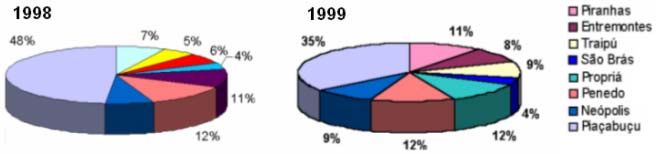
Municipality/location Production
(kg)
contribution
(%)
Piranhas 14,188.8 7.12
Entremontes 10,191.1
5.11
Traipú 11,560.4 5.80
São Brás
7,103.8
3.56
Própria 21,103.9
10.58
Penedo 24,583.5
12.33
Neópolis 14,514.8 7.27
Piaçabuçú 96,185.5 48.23
TOTAL 199,431.8
100.00
Figure 21. Production per Municipality/Location (1998 99).
All locations, except for Penedo and Piaçabuçú, increased their share in the total fishing
production, in comparison with 1998 (Figure 22).
Figure 22. Contribution to the total (%), per Municipality/Location (1998 -99).
xlvii
Chart 17. Monthly production(kg), per Municipality/Location (1998)
Entre-
Meses Piranhas
Traipú
S. Brás
Propriá
Penedo Neópolis Piaçabuçu TOTAL
montes
Jan.
1,277.2
836.4
965.1
779.9
2,039.5
2,710.1
1,894.1 10,735.0 21,237.3
Feb.
1,127.9
796.0
766.7
503.1
1,353.3
1,457.8
1,405.0
8,637.0 16,046.8
Mar.
1,405.6
1,598.8
1,024.4
752.9
1,430.0
2,080.1
1,478.5 12,829.0 22,599.3
Apr.
1,026.1
633.5
672.5
571.8
1,447.3
1,790.2
854.2
9,542.5
16,538.1
May
1,418.8
764.1
1,323.1
756.4
1,410.0
2,356.7
1,104.1 10,006.0 19,139.2
Jun.
1,310.5
602.0
1,130.7
746.8
1,472.0
1,713.0
862.5
10,281.0
18,118.5
Jul.
1,213.7
895.6
1,488.4
723.7
1,400.1
1,980.6
1,113.8
8,410.0 17,225.9
Aug.
1,181.3
1,012.7
1,236.8
418.4
2,633.0
2,368.0
992.5
7,236.0
17,078.7
Sep.
974.8
1,012.8
922.6
512.9
1,855.6
1,721.4
820.3
7,056.0
14,876.4
Oct.
993.2
990.7
907.6
503.0
2,740.1
1,957.2
1,055.8
2,819.0
11,966.6
Nov.
1,180.5
531.7
520.1
482.5
2,082.7
1,614.6
1,249.9
4,726.0 12,388.0
Dec.
1,079.2
516.8
602.4
352.4
1,240.3
2,833.8
1,684.1
3,908.0 12,217.0
TOTAL 14,188.8 10,191.1
11,560.4
7,103.8
21,103.9
24,583.5
14,514.8 96,185.5 199,431.8
Traipú is the only disembarkment location with records from previous years, as shown in Chart
18 (Source: Fishing Statistics of the State of Alagoas, labmar/ufal, Issues number 02 and 03,
1974-75 data).
Chart 18. Production in Traipú (1974, 75, 98 and 99).
Year Production
(kg)
1974 96,317.0
1975 70,540.0
1998 11,560.4
1999 14,937.4
Ichthyofauna in the Lower São Francisco is represented by marine and estuarine species, with
expressive participation in the disembarkments at Piaçabuçu and Penedo, especially the
Carangidae Family (anchovy = palombeta) and typical freshwater species. The latter include
exotic species of the Cichlidae (peacock bass and tilapia), Cyprinidae (carp) and Characidae
(black pacu) Families. The presence of a hybrid was verified: the tambacu, resulting from the
cross-breeding of the pacu and the black pacu.
xlviii
Identification of the individual species shows that the marine and estuarine ichthyofauna
disembarked in the eight sampling sites is represented by seven and six main families,
respectively. The relative participation of these families is displayed in Figures 23 and 24.
Figure 23. Relative participation of the main families in the freshwater ichthyofauna of the
Lower São Francisco (1998 / 1999).
Figure 24. Relative participation of the main families in the marine and estuarine
ichthyofauna of the Lower São Francisco (1998 / 1999).
The relative participation of the introduced species, in the disembarkment, was 18.7%, in 1998,
and 22.4 e%, in 1999. The peacock bass (Cichla sp.) was the most frequent species, reaching a
6.2 tons production, in 1998, and 10.5 tons in 1999. The second most frequent was the tilapia
(Oreochromis sp.), with productions of 2.1 and 1,7 tons, in 1998 and 199, respectively.
The reophylic species with a high commercial value, such as the sorubim (Pseudoplatystoma
coruscans) and the dourado (Salminus brasiliensis), had inexpressive participation in the
disembarkment, with a maximum of one ton, in 1999.
General aspects of the fishing in the Lower São Francisco, regarding fishing devices, boat kinds
and fish trade, are illustrate by the sequence of pictures which constitute the Documentary on the
Ichthyofauna and Fishing on the Alagoan São Francisco (Costa,2003).
xlix
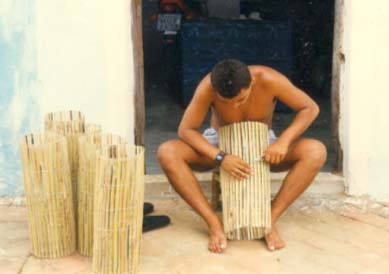
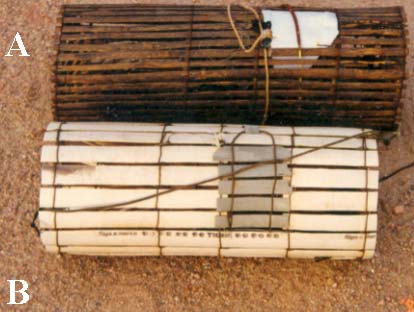
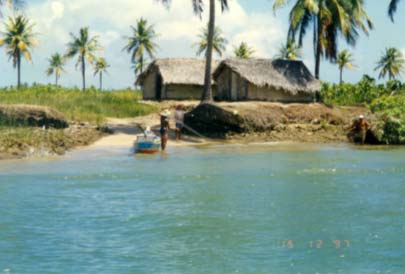
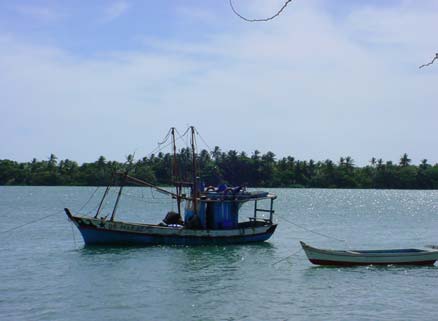
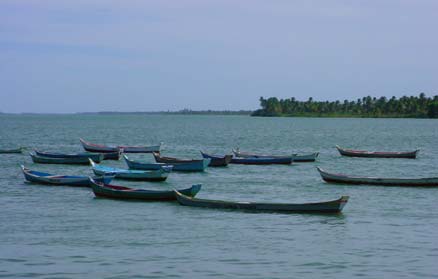
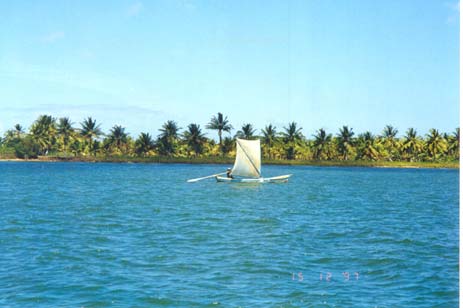
Picture 21. Making fish traps.
Picture 22. Wood (A) e PVC (B) fish traps.
Picture 23. Fisherman's house, by the
Picture 24. Sea fishing boat.
River's mouth.
Picture 25. Fishing canoes (Piaçabuçú).
Picture 26. Fishing sail-boat.
l
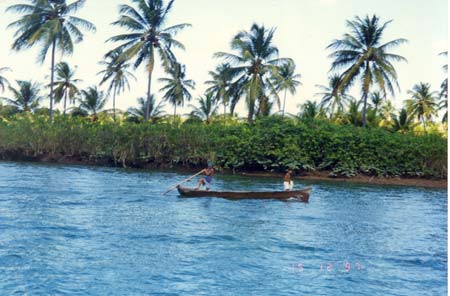
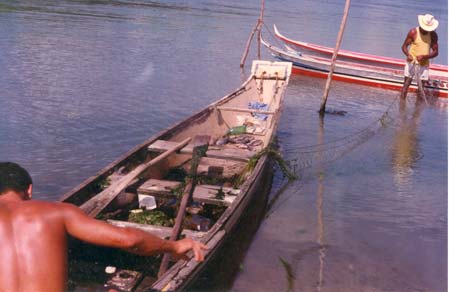
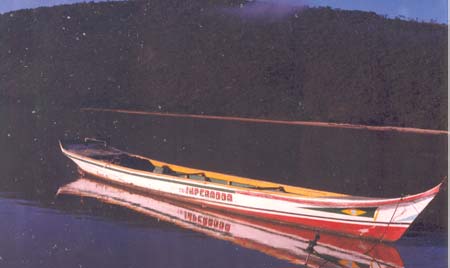
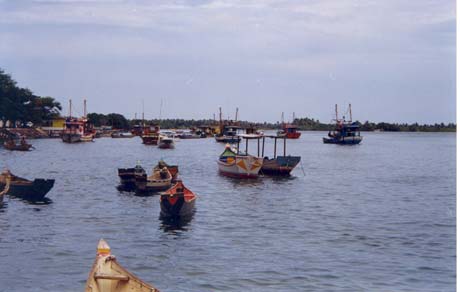
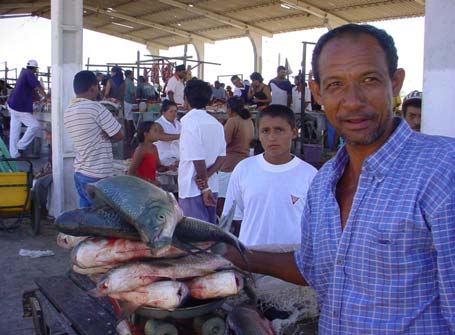
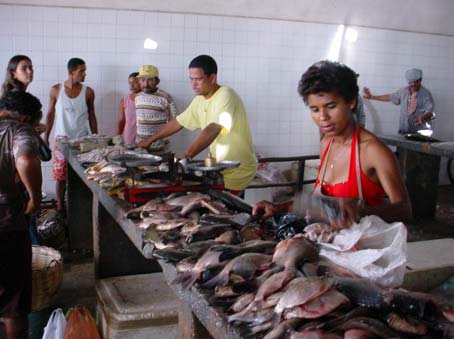
Picture 27. Rowing Pesca em canoa a remo. Picture
28.
Taking
off the macrophytes
from the net, after fishing.
Picture 29. Fishing canoe (Traipú).
Picture 30. Boats in Piaçabuçú.
Picture 36. Free market in Piranhas.
Picture 38. Fish market in Penedo.
li
8.
RE-POPULATING THE XINGÓ RESERVOIR
In the case of the Xingó Reservoir, studies on the structure of fish populations, under the new
situation, are scarce. It is imperative to carry them out, at once, to provide the necessary
information to assess the stocks.
The lack of information regarding other issues, such as zoning of eggs and fish larvae
concentration areas, turned impossible any attempts to re-populate the Reservoir. However, this
management alternative (re-populating) must be pursued, in the Xingó case, as there are no long
free stretches upstream.
In this direction, Activity 1.3 began the first surveys, aiming at characterizing the composition,
the ichthyofauna's diversity and the fishing production in the ecosystem. It proceeded with the
identification and selection of areas passible of stocking, carrying out ywo limnologic campaigns
in the pre-selected areas.
8.1. RE-POPULATING
AREAS
8.1.1. IdentificaTION AND Selection of Re-Populating Sites
The decision about the stocking areas is one of the premises for the success of a re-populating
program. With that in mind, the Activity's technical team ran all the extension of the Reservoir,
in an attempt to identify, characterize and select the re-populating sites.
The nine identified areas are shown in Figure 25. All of them are close to the confluence of
streams, as there are no permanent tributaries in the stretches upstream of the Xingó Power Plant.
8.1.2. Physical, Chemical and Biological Parameters of the Re-Populating Areas
Previously, a limnologic campaign was carried out in the Reservoir, in order to verify the spatial
variation (channel and reentrances) and the diverse physical, chemical and biologicaç parmeters.
He sample collection stations are listed in Chart 36.
Chart 36. Preliminary Collection Stations (Mar.2002)
Stations
UTM Coordinates (24L)
1. Pau de Arara Stream
0632230 E / 8937469 N
2. Near the dam
0631640 E / 8937087 N
3. Reentrance upstream from the Pau de Arara Stream
0631343 E / 8937805 N
4. Reentrance downstream from Luiz Xavier's farm
0631277 E / 8938563 N
5. Fish-tank modules (Luiz Xavier's farm)
0629923 E / 8939772 N
6. Talhado Stream
0621453 E / 8950159 N
lii
lv
Figure 25. Re-populating areas in the Xingó Reservoir.
Water samples were colected in a Van Dorn type of bottle, with 2.2 liter capacity, at two depths
(surface and bottom), in five of the six Stations (Chart 37), after measurementof the maximum
depth. The vertical profiles were determined for the six Stations, with direct measurement of
temperature and dissolved oxygen, with the help of a portable measuring device (Oxymeter
WTW OXI 197).
Chart 37. Physical, Chemical and Biological Parameters in the Xingó Reservoir (Mar.2002)
O
Nitrate
Turbidity
Stations
Secchi
2 saturation
(m)
(%)
N.NO -3 (mg/l)
(NTU)
S 68.2
0.054
12.0
Pau de Arara Stream
1.0
B
51.0 0.075 12.0
S 69.0
0.044
13.0
Near the dam
1.5
B
35.8 0.047 2.0
Reentrance upstream
S 79.7
0.029
6.7
from the Pau de Arara
1.5
B
64.3 0.052 8.2
Stream.
S 74.9
0.081
9.5
Reentrance downstream
1.0
from Luiz Xavier's farm.
B
S 66.8
0.045
8.5
Fish-tank modules (Luiz
1.0
Xavier's farm).
B
54.6 0.041 6.5
Total
Ammonia
Dissolved
Chlorophyll
phosphor
(mg/l)
phosphor (mg/l)
(mg/l)
(µg/l)
S 0.04 0.128
0.049
3.47
Pau de Arara Stream
B 0.06
0.155
0.098
S 0.04 0.108
0.065
3.21
Near the dam
B 0.02
0.074
0.049
Reentrance upstream
S 0.02 0.094
0.065
4.28
from the Pau de Arara
B 0.05
0.128
0.082
Stream.
S 0.02 0.141
0.114
4.54
Reentrance downstream
from Luiz Xavier's farm.
B
S 0.03 0.121
0.065
3.68
Fish-tank modules (Luiz
Xavier's farm).
B 0.02 0.128
0.049
Note: S-Surface/B-bottom
liv
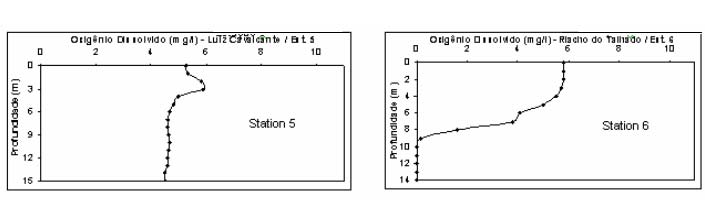
The water temperature profiles show stratification in some stations, with emphasis on Station 5
(see Figure 26).
Figure 26. Water temperature profiles in the Xingó Reservoir (Mar. 2002)
The dissolved oxygen profiles did not present strong variations in the stations, except for Station
6 (Talhado Stream), which presented a significant stratification, with dissolved oxygen levels
reaching zero mg/l, after a 10 m depth (Figure 27).
Figure 27 Dissolved oxygen profiles in the Xingó Reservoir (Mar. 2002)
Based on historic and current data, nine areas with favorable characteristics for stocking native
species were identified and selected (vide Chart 38).
lv
Chart 38. Re-Populating Areas (Aug./2002)
Selected sites in the Reservoir
UTM Coordinates (24L)
1 . Pau de Arara Stream
0632206 E / 8937468 N
2 . Curituba Stream
0623921 E / 8938623 N
3 . Uruçu Stream
0627219 E / 8942673 N
4 . Poço da Cachoeira Stream
0623984 E / 8941132 N
5 . Águas Mortas Stream
0623540 E / 8947216 N
6. Olho d'Água Stream
0619177 E / 8946389 N
7. Grande Xingó Stream
0609391 E / 8947482 N
8. Mandu Stream
0606655 E / 8950790 N
9. Baixa da Velha Stream
0606097 E / 8951223 N
Some physico-chemical parameters were measured in situ at the selected re-populating sites, at
the surface, with the help of portable measuring devices (Chart 39).
Chart 39. Physico-Chemical Parameters of Water in theSelected areas (Aug./2002)
Electrical
Dissolved
Oxygen
Max.
Temperature
Station
pH
Condutivity
oxygen
Saturation
depth (m)
(°C)
(µS/cm)
(mg/l)
(%)
1 - Pau de Arara Stream
34.0
8.15
24.7
75.5
7.56
97.0
2 - Curituba Stream
8.5
8.67
26.7
79.9
7.87
97.3
3 - Uruçu Stream
7.0
8.37
25.6
78.3
7.63
98.4
4 - Poço da Cachoeira
25.5 8.42
25.3
71.4 7.81 91.2
Stream
5 - Águas Mortas Stream
54.0
8.92
25.3
84.8
8.62
81.4
6 - Olho d'Água Stream
9.5
9.59
26.4
80.5
8.40
105.6
7 - Grande Xingó Stream
6.5
8.41
25.7
111.1
6.88
150.2
8 - Stream do Mandu
13.0
8.15
26.9
127.5
8.09
100.0
9 - Stream Baixa da Velha
11.0
7.80
27.3
129.0
7.88
94.3
lvi
8.2. PRODUCTION AND STOCKING OF THE YOUNG FISH
Until the early 80's, only two native species of the São Francisco Basin were artificially hatched:
produced: The curimatã-pacu (Prochilodus marggravi) and the "true" piau (Leporinus
elongatus). With the research done at CODEVASF's Piscuculture Station, it was also possible to
produce, regularly, young fish of 14 other species, with emphasis to the sorubim
(Pseudoplatystoma coruscans), the dourado (Salminus brasiliensis), the pirá (Conorhyncus
conirostris), the yellow mandí (Pimelodus maculatus) and the matrinchã (Brycon lundii).
In 1977, CODEVASF implemented the "Live Fish Project", near the Marituba do Peixe Village
(Municipality of Penedo), in the Lower São Francisco, in partnership with the fishermen
community. This Project consists of raising young fish of native species, such as the true piau
(Leporinus elongatus) and the curimatã-pacu (Prochilodus marggravi), in cages installed into the
Marituba River, until they reach 12 to 15 cm, when they are to be released into the natural
environment.
The Pisciculture Station of the São Francisco Hydroelectric Power Company, located in the
Municipality of Paulo Afonso (BA), maintains pure bred breeding stocks of the following native
species: curimatã-pacu (Prochilodus argentus), dourado (Salminus brasiliensis), pacman catfish
(Lophiosilurus alexandri), oremon catfish (Pseudopimelodus fowleri), two-spot tetra (Astyanax
bimaculatus), true piau verdadeiro (Leporinus elongatus), sorubim(Pseudoplatystoma coruscans)
and cari (Pterygoplichthys etentaculatus).
In its almost 30 years of operation, the Pisciculture Station has been producing young fish of
native species, specially curimatãs, piaus and pacman catfish, in order to re-populate CHESF's
lakes and reservoirs.
The available information on the production of post-larvae and young fish of native species
indicate that the current production is adequate to meet the re-populating demands. Even though
some re-populating has been done in the Lower São Francisco, no posterior monitoring was
carried out, which impedes the evaluation of those actions.
9.
CONCLUSÕES
Characterization of the San Francisco Basin
· The Lower São Francisco's ichthyofauna is little studied, what is proven by the small
number of works on the regional fish. This fact exposes taxonomic abd ecologic doubts.
· Some important fish species disappeared almos completely, as it happened to the pirá
(Conorhynchus conirostris), without any signs for the past 20 years.
· The big migratory fish, such as the sorubim(Pseudoplatystoma coruscans) and the
dourado (Salminus brasiliensis), had their population extremely reduced.
The insertion of the Xingó Power Plant Reservoir in the San Francisco Basin
· No diagnosis of the ichthyofauna has been made, after the formation of the Xingó
Reservoir.
lvii
· Studies about the structure of fish populations are scarce, turning imperative their
immediate implementation, to provide subsidies for sizing the stocks, and for efficient
procedures viewing the management and protection of fishing resources.
· Fish breeding in cages is an activity which has been consolidating in the Region,
particularly in the Xingó Reservoir.
Limnology of the Xingó Reservoir and downstream reaches
· The oligotrophical characteristics and the high transparency of the water column favor
the development of submersed macrophytes in the floodplains.
Phyto/Zooplanktonic Communities in the Xingó Reservoir
· The Xingó Power Plant Reservoir might be considered one with "clear" waters, given
the diversity values of the phytoplanktonic communities.
· The dominance of the Notodiaptomus cearensis species suggests an oligomesotrophic
environment for the Reservoir.
The Lower São Francisco's Ichthyofauna
· The Lower São Francisco's ichthyofauna is not well studied, if compared to other
Basins.
· There is a significative occurrence of introduced species, from other basins and regions.
· The impacts of anthropic actions on the structure and behavior of the fragile and rich
ecosystems of the Lower São Francisco affect not only the big migratory fish, but the
sedentary species as well.
Fishing Cultural Evolution in the Lower São Francisco, in Alagoas: Ethnoecological
Approach with Emphasis on Fishing Strategies
· The ecologic knowledge of the fishermen, being an important source of information for
fishing management, should be used as an strategy for occupying new spaces in the
exchange of experiences and learning, among the diverse users, knowledge developers
and public administrators.
· The environmental changes caused by the construction of the Power Plant were
determinant in the changes in the raw materials used for making fish traps in the Lower
São Francisco.
Fish Production in the Lower São Francisco
Based on the analysis of the fishing activities along the São Francisco, it is possible to highlight
the following:
· The drop in fishing production disembarked in the eight control points, in the period of
study (1998/99);
lviii
· The freshwater species presenting the greatest volume of catch is the curimatã
(Prochilodus sp.), probably due to the stocking practice implemented in the Region by
the ichthyofauna re-populating programs;
· The significative presence of introduced species, particularly the peacock bass (Cichla
ocellaris) and the tila Oreochromis niloticus);
· The little participation, in the disembarkments, of migratory species such as the sorubim
and the dourado, whose spawning coincide with the rainy season;
· Besides the rational monitoring of the fishing, which should not be limited to the
temporary suspension of fishing, it is necessary to extend the control to other anthropic
actions (changes in river stages due to upstream reservoirs operation, degradation of
spawning sites and natural hatcheries, contamination, etc.);
· Lack of monitoring during the gonadal cycle of the species, in view of the changes
imposed to the River, which demands an evaluation of the legislation adopted for the
Lower São Francisco.
Re-populating the Xingó Power Plant Reservoir
· Implementation of the ichthyofauna recomposition program requires additional
information on the zoning of eggs and fish larvae and an ichthyofauna survey of the A
implementação do programa de recomposição da ichthyofauna exige informações
adicionais sobre o zoneamento de ovos e larvas de peixes e do levantamento da fauna
ictiológica do reservatório da UHE de Xingó.
10. RECOMMENDATIONS
10.1. IMPLEMENTATION OF A PERMANENT RE-POPOPULATING AND FISH
DISEMBARKMENT CONTROL PROGRAM IN THE LOWER SÃO FRANCISCO
Analysis of the historic data obtained by the Activity indicate that fishing activities in the Lower
São Francisco are in evident decline, due to several problems, amog which are the following:
· Barriers to the reproduction and feeding migrations of the fish;
· Reduction in fish spawnig habitats;
· River flow regulation, due to reservoir operation;
· Increase in predatory fishing;
· Sediment deposition in river channels;
· Lack of governmental support for administrative capacitation of the fishermen, viewing
a participative management.
The whole situation, aggravated buy the fishermen's low conditions of life, has been the cause for
inadequate fish exploitation, compromising the already vulnerable stocks. Record of production
and fishing activities do not include historical series of data, making control even more difficult.
lix
With the environmental changes and the impacts on the aquatic fauna, the fishing legislation,
originally focused on the migratory species, became obsolete. The current defense period, which
determines the temporary suspension of fishing activities, for example, is totally contested by
fishermen and by segments of the organized society.
The current local structure, which received support from the GEF São Francisco Project, for its
consolidation, corresponds only to part of the required infrastructure for implementing the
ichthyofauna reconstitution program. It is necessary further suport, so that the involved
institutions, particularly the IBAMA, take over the continuity of the actions, assuring its
sustainability.
Two strategic actions are recommended here, aiming at rationalization of the fishing and
preservation of the biodiversity. Those actions are planned for a 3-year period.
Action I Re-populating (stocking native species, from laboratory reproduction and/or
acquisition of young fish, from other institutions)
Methodology:
· Forming a breeding stock and acquisition of young fish of native species;
· Identifying and selecting re-populating sites;
· Limnologic monitoring;
· A dissemination program for the riverine communities and fishermen
colonies/associations;
· Re-populating;
· Monitoring of fish disembarkment.
Action II Implementing a Fish Disembarkment Control System.
Methodology:
· Reconnoissance of the Municipalities/Locations;
· Meeting with local leaders;
· Selecting the sites for continuous data collection on fish disembarkment;
· Selection of data collection personnel, among the local guides;
· Preparing Structural Census Forms;
· Preparing Disembarkment Control Forms;
· Data coding, typing and processing;
· Spreading out the results.
lx
Total Cost of the Program
Discrimination total
(US$)
Estimated costs for the donor institution
214,100
Institution's counterpart
470,500
Global Cost
684,600
10.2. AQUICULTURE INCENTIVE PROGRAM
Fishing production in the Lower São Francisco has been decreasing in the past years. The total
production disembarked in eight Municipalities, in 1999, presented a 12.8% reduction, in
comparison with 1998. The fishermen perceive, for at least a decade, the "time of the river" is no
longer associated or marked by the great floods that regulate fishing.
Handcraft fishing, considered as a source of food and support for the fishermen, is far from
representing a sustainable future. There are diverse and multiple economic, ecological and
cultural pressures on the activity, what affects enormously its maintainance.
The resulting adverse impacts, mainly due to the dams, particularly on the ichthyofauna, has been
cutting on the fishing stocks of authoctone migratory species of commercial value. For this
reason, preservation of the resources demands the adoption of more intense management
programs. And, to overcome the problem, several innitiatives have been presented, with especial
emphasis to the incorporation of aquiculture to the activities of the handcraft fisherman, which
would turn him into an aquicultor.
The Xingó Technologic and Scientific Development Institute, in partnership with CODEVASF,
has been developing works in several communities, to promote the use of fish tanks in
pisciculture. Financial complementary support will permit the incorporation of skills and
meanings that are still away from the traditional fisherman's culture. Additionally, it will
strengthen initiatives related to social organization and to a better structures associativism.
Methodology
· Setting up aquiculture production demonstrative units, as tools for validating the
production process and spreading out the technology;
· Preparing and offering courses on fish production in cages, on quality principles, and on
the control of fish processing, transportation and trade, as well as on associativism and
cooperativism.
· Preparing guidelines for training the handcraft fishermen on the use of fish cages.
lxi
Total Cost of the Program
discrimination TOTAL
(US$)
Estimated costs for the donor institution
49,000
Institution's counterpart
470,500
Global cost
519,500
10.3. CREATION OF TWO SUPPORT CENTERS FOR THE FISHERMEN (PENEDO
AND PRÓPRIA)
Objectives
· Centralize all information necessary for the sustainable management of the fishing
(creation of many Help Boxes for the fishermen: INSS, IBAMA, Ministry of
Agriculture, Ministry of Justice, Navy).
· Creating an space for a permanent participative management forum, where universities,
Federal, State and Municipal agencies may discuss, jointly, and contribute to the solution
of existing problems.
· Creation of an information center, for training the sons of fishermen and capacitating the
colonies in the use of computer data.
· Setting up permanent public fishing expositions (fish, fishing strategies, innovations,
etc.) and other activities (bring fishermen to give out lectures, for example).
· Setting up exhibition rooms for artcrafts produced by the fishermen's women (laces,
pottery, etc.).
· Implementing workshops related to the making of fishing equipment, where the Elder
would teach the younger fishermen.
Proposal of Activities
· Implementation of workshops and trainings on Participative Research Methodology and
on Community Planning. UFAL is a co-proponent of the Brazil-Canada bi-lateral Project
on "Interior Fishing in Brazil: Conservation and Participative Management".
· 20-hour course for capacitating communities to participate in the management process.
· Preparing a didactic book on fishing in the Lower São Francisco, aiming at adding value
to the fishermen's culture in the educational network, at elementary level.
Estimated Costs for Creating the two Fishermen's Support Centers
lxii
The creation of the two centers requires partnership with the local Prefectures (Penedo e
Piranhas), that might donate the area for the construction.
Estimated Costs for Building the two Centers:
discrimination total
(US$)
Estimated costs for the donor institution
60,000
Institution's counterpart
200,000
Global costs
260,000
10.4. PREPARING THE DIDACTIC BOOK FOR THE EDUCATIONAL NETWORK
Objective
· Transform the results of published works on the fishing on the Lower São Francisco, in
diverse áreas (socio-economical, ethnological, ecological, geological, etc.), into texts
aimed at each level of the elementary schools. The objective is to insert "fishhing in the
São Francisco" as a transversal topic, up for discussion in all disciplines.
Proposal of Activities
· Survey of existing publications and creation of a data base;
· 2-month course on "Fishermen's Right", aimed at students (Biology, Law, Sociology,
Pedagogy, etc.).
· Preparation of the didactic book, compliant with the National Curriculum Parameters,
including discussions of the texts with a pedagogue.
· Scheduling meetings with the Fishermen Colonies, teaching establishments in the Lower
São Francisco and those with interests on the work.
· Training local instructors, for reading the texts, making suggestions and reviewing
documents.
· Organizing the tests and using the material in a pilot school (500 copies).
· Publishing a preliminary version of the books.
Estimated Costs of the Book for the Elementary Educational Network
The idea is to add value to the fishermen`s culture, restoring their ethnoecological knowledge
about fish, crustaceans and the environment, and use it in association with a scientific
understanding, in the elementary school disciplines.
lxiii
With a vast material already collected, the book would be prepared by a multidisciplinary team,
composed of students of pedagogy, biology and social sciences, with scholarships. The Project is
to be implemented in six months.
Estimated Costs for Preparing the Book:
Discrimination Total
(US$)
Estimated costs for the donor institution
36,500
Institution's counterpart
200,000
Global cost
236,500
lxiv